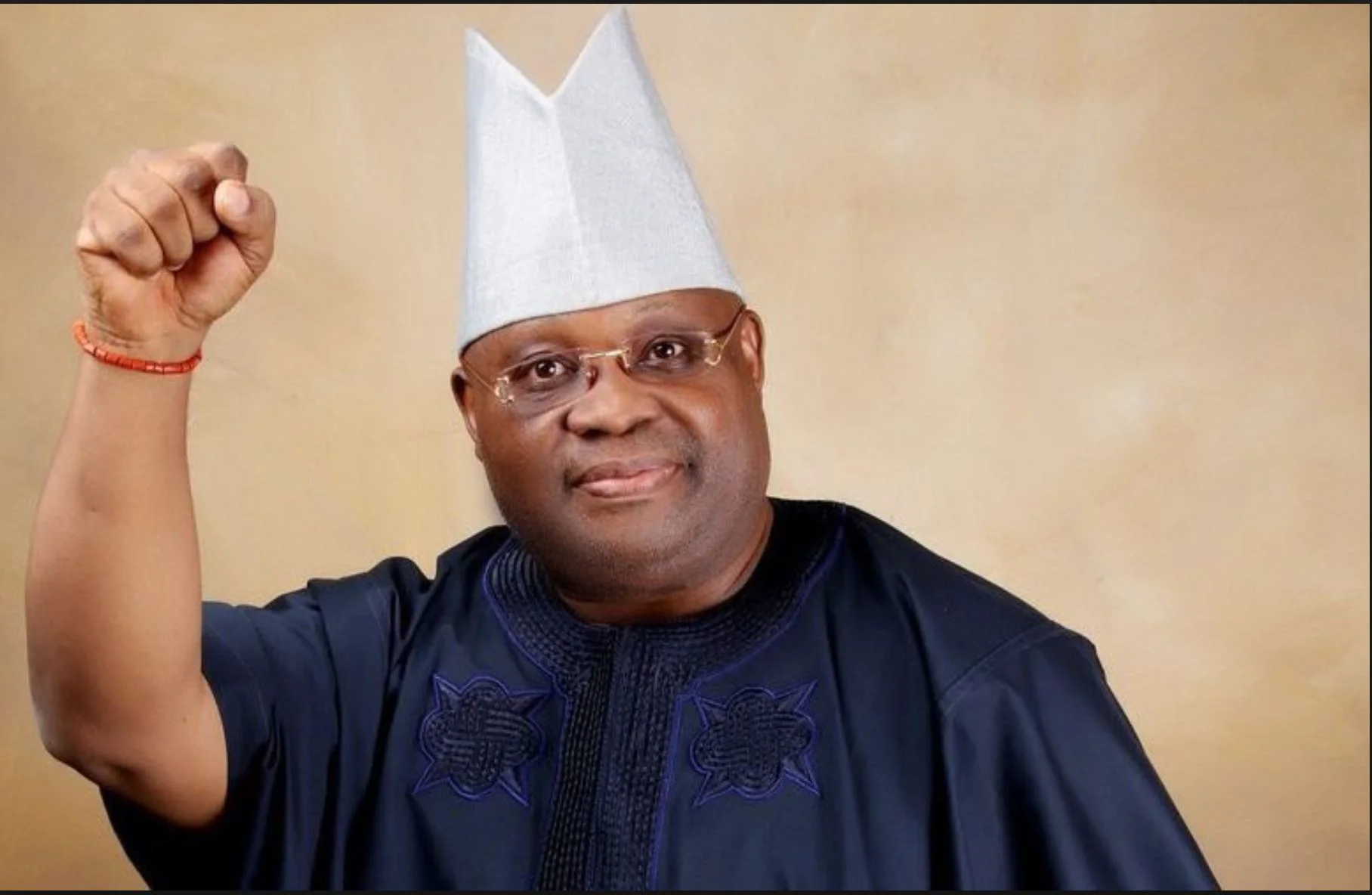
Governor Ademola Adeleke’s victory in the 2026 Osun State governorship election represents more than a successful re-election campaign. It marks a significant political upset, secured on a relatively smaller platform against the formidable national machinery of the ruling All Progressives Congress.
Adeleke, who contested under the Accord Party, received 511,067 votes to defeat APC candidate Bola Oyebamiji, who polled 444,815 votes. The 66,252-vote margin was more than double the 28,344 votes with which Adeleke defeated former governor Gboyega Oyetola in 2022.
African Democratic Congress candidate Najeem Salaam finished third with 17,180 votes.
The State Returning Officer and Vice-Chancellor of the Federal University, Oye-Ekiti, Professor Joshua Olalekan Ogunwole, declared Adeleke the winner after the governor secured the highest number of votes and satisfied the legal requirements for election.
ALSO: Adeleke Demands Release of Osun PDP Chairman Sunday Bisi
“That Ademola Nurudeen-Jackson Adeleke, having satisfied the requirements of the law, is hereby declared the winner of the August 15 governorship election and returned elected,” Ogunwole announced.
Adeleke won 19 of Osun State’s 30 local government areas, while Oyebamiji carried the remaining 11.
The governor prevailed in Ede North, Ede South, Ejigbo, Iwo, Egbedore, Ife North, Ife East, Ife Central, Ila, Oriade, Ifelodun, Orolu, Ayedaade, Odo Otin, Boluwaduro, Ilesa West, Ifedayo, Osogbo and Ayedire.
Oyebamiji won Ilesa East, Boripe, Irepodun, Obokun, Atakunmosa West, Irewole, Atakunmosa East, Isokan, Ola Oluwa, Ife South and Olorunda.
INEC recorded 2,339,233 registered voters for the election. A total of 1,005,800 votes were cast, representing a turnout of approximately 43 per cent. Of that figure, 20,721 ballots were rejected.
From PDP to Accord: Adeleke’s high-risk political gamble
Adeleke’s route to re-election was complicated by the political crisis within the Peoples Democratic Party, the platform on which he became governor in 2022.
Amid disagreements and leadership battles within the PDP, Adeleke resigned from the party in December 2025 and moved to the Accord Party.
In his resignation letter to the PDP chairman of Ward 2, Sagba Abogunde, in Ede North Local Government Area, the governor cited the crisis within the party’s national leadership as the reason for his departure.
He subsequently explained that Accord’s welfarist philosophy aligned with his administration’s focus on workers and residents.
The decision represented a considerable political risk. Adeleke abandoned one of Nigeria’s largest opposition parties months before seeking re-election and moved to a platform without the PDP’s established national structure.
His victory demonstrated that his political base, personal appeal and local campaign network could be transferred successfully from the PDP to Accord.
It also showed the limits of relying solely on traditional party structures in an election shaped by incumbency, local loyalties, grassroots mobilisation and the personalities of the leading candidates.
APC’s heavyweight campaign fails to reclaim Osun
The APC entered the contest determined to return to power after losing Osun State in 2022.
The party and its progressive predecessors governed Osun continuously for 12 years, beginning with Rauf Aregbesola’s assumption of office in November 2010 following a court judgment on the 2007 election.
Aregbesola served two terms before handing over to Oyetola in 2018. The political succession ended in 2022 when Adeleke, then the PDP candidate, polled 403,371 votes to defeat Oyetola, who received 375,027.
Four years later, Oyetola returned to the campaign as Minister of Marine and Blue Economy and a leading strategist in Oyebamiji’s attempt to reclaim the state for the APC.
The national ruling party deployed several prominent figures to Osun during the campaign. They included governors, federal officials and senior party leaders seeking to strengthen the APC’s mobilisation across the state.
Among those involved were Imo State Governor Hope Uzodimma, Yobe State Governor Mai Mala Buni, Ekiti State Governor Biodun Oyebanji, Ogun State Governor Dapo Abiodun, Ondo State Governor Lucky Aiyedatiwa, Lagos State Governor Babajide Sanwo-Olu and Cross River State Governor Bassey Otu.
Senate President Godswill Akpabio, House of Representatives Speaker Tajudeen Abbas and other national APC leaders also participated in campaign activities.
Despite this heavyweight deployment, the APC was unable to overcome Adeleke’s support in critical population centres and his strongholds across Osun.
The governor’s victories in Ede North, Ede South, Osogbo, Iwo and parts of the Ife axis contributed significantly to the statewide margin. He also retained enough support in competitive areas to prevent the APC from building an offsetting advantage.
The result reinforced an enduring reality of Nigerian state elections: national power and federal influence may strengthen a campaign, but local organisation, candidate popularity and voter relationships remain decisive.
The Davido factor and youth mobilisation
Adeleke’s campaign also benefited from the active involvement of his nephew, Afrobeats singer David Adeleke, popularly known as Davido.
Davido participated in campaign events, mobilised young voters and used his social media platforms to communicate directly with supporters.
In the days before the election, he repeatedly alleged that Accord members faced intimidation and possible arrests. On Thursday, he urged party supporters to remain vigilant.
“Accord members, stay safe! Just got intel, the next few hours they want to start arresting our people for nothing,” he wrote on X.
“The plan cannot work. Stay safe. Mount your guard. We are coasting to victory.”
On election day, the singer continued posting updates, raising concerns about security deployments and alleged attempts to interfere with the process.
Davido’s involvement did not replace Accord’s political structure, but it gave the campaign greater visibility among younger voters and amplified information from Adeleke’s supporters.
His prominence also transformed the Osun election into a national digital event, with polling-unit reports, allegations and campaign messages receiving attention beyond the state.
Tinubu congratulates Adeleke, calls result people’s will
President Bola Tinubu congratulated Adeleke following his declaration as the winner, describing the result as a reflection of the electorate’s decision.
In a statement issued by his Special Adviser on Information and Strategy, Bayo Onanuga, Tinubu disclosed that he had spoken with Adeleke by telephone.
“I called Governor Ademola Adeleke earlier today to congratulate him on his election victory in Osun State. His victory once again confirmed the confidence the people of Osun State have in him,” the President said.
Tinubu urged the governor to unite residents irrespective of their political choices and work towards the state’s economic and social development.
He also praised the other contestants, INEC and security agencies for their roles in the election. The State House statement described the outcome as an assurance that democracy would continue to flourish.
The President’s response was politically significant. Despite leading the APC nationally, Tinubu accepted the defeat of his party’s candidate and publicly recognised Adeleke’s victory.
Adeleke renews support for Tinubu’s 2027 bid
Following his victory, Adeleke thanked Tinubu for supporting what he described as a free and fair electoral process.
The governor confirmed receiving a congratulatory telephone call from the President and reaffirmed his support for Tinubu’s re-election in 2027.
“At this point, I must deeply appreciate Mr President, His Excellency Senator Bola Ahmed Tinubu, for his strong support for a free and fair election,” Adeleke said.
“Mr President is a son of Osun State, and I hereby reaffirm my earlier endorsement of him for a second term in the 2027 presidential election.”
Aviation and Aerospace Development Minister Festus Keyamo welcomed the endorsement and congratulated Adeleke on his victory.
“Thank you, Governor Ademola Adeleke, for the public and unequivocal endorsement of President Bola Ahmed Tinubu for the 2027 presidential election,” Keyamo wrote on X.
“You are a man of integrity and honour. ‘Agreement is agreement.’”
The comment triggered speculation that Adeleke and the Presidency had reached a political understanding before the election.
Adeleke’s campaign council rejected that interpretation. Its spokesperson, Pelumi Olajengbesi, said the governor’s support for Tinubu was based on his assessment of the President’s performance and reforms.
“Do not undermine the resilience of the Osun people. There is no agreement,” he said.
Osun APC considers legal challenge
Although Tinubu congratulated Adeleke, the Osun APC indicated that it could challenge the result.
The party’s Director of Media and Information, Kola Olabisi, said the leadership was reviewing results from the state’s 332 wards and consulting its legal team.
“We are currently studying the results of the governorship election in each of the 332 wards across the state with a view to exploring further the allowed constitutional window of opportunity in this regard,” the party said.
It argued that the electoral process could extend beyond INEC’s declaration to the election petition tribunal and appellate courts where a party believed irregularities had affected the outcome.
The APC called on its supporters to remain calm while its review continued. It had not formally filed a petition at the time of the statement.
IPAC endorses outcome but condemns vote buying
The Osun State chapter of the Inter-Party Advisory Council congratulated Adeleke and described the outcome as reflecting public confidence in his administration.
State IPAC Chairman Odesola Titus commended voters, INEC and security agencies for their respective roles in the election.
The council, however, expressed concern about reports of voter inducement and warned that vote buying undermined the integrity of elections.
“Such action undermines the integrity of our democratic process and must be addressed to uphold the principles of democracy and fairness in our elections,” IPAC said.
It urged political actors, electoral authorities and other stakeholders to strengthen safeguards against inducement in future elections.
A victory with implications beyond Osun
Adeleke’s re-election has implications beyond the state.
The result shows that a popular incumbent can survive a late change of party when supported by a strong grassroots network and recognisable political identity. It also demonstrates that smaller parties can defeat nationally dominant platforms under the right local conditions.
For Accord, the victory provides its most significant electoral breakthrough in Osun and raises the party’s national profile ahead of the 2027 general election.
For the APC, the defeat will prompt questions about the effectiveness of deploying national party figures against a well-established local political structure.
For Adeleke, the immediate task is to convert electoral success into a second-term mandate capable of addressing Osun’s economic, infrastructural and social challenges.
His victory has secured another four years in office. How he governs during that period will ultimately determine whether the election is remembered merely as an upset—or as the beginning of a more consequential political realignment in Osun State.