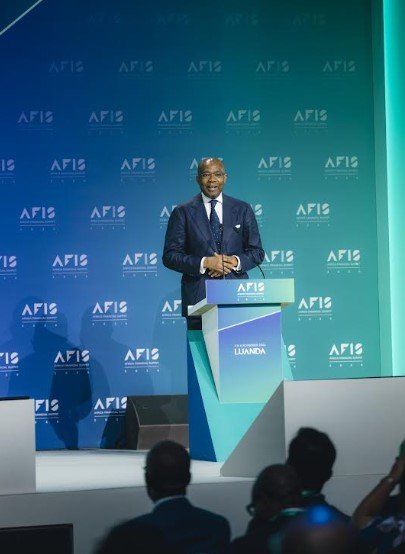
Aig-Imoukhuede has urged African Financial Leaders to make capital count for productivity.
NewsOnline Nigeria reports that the Chairman of Access Holdings Plc, Aigboje Aig-Imoukhuede, has urged African policymakers, central bankers and financial institutions to judge progress by how effectively capital is deployed to create productivity and prosperity, not by its volume, ownership or cost.
He made the call in the keynote address at the closing session of the African Financial Industry Summit (AFIS) 2026 in Luanda. The address was themed “Making Capital Count: From Financial Stability to Productivity, Prosperity and African Integration.”
The summit drew more than 1,500 participants and a reported record 18 central bank governors. Aig-Imoukhuede said this showed Africa was building stronger consensus on the reforms needed for economic transformation.
He warned, however, that capital, resilient banks and macroeconomic stability would not automatically deliver the continent’s development goals. He noted that several African economies had made progress in managing inflation, currency volatility and financial-sector risk.
ALSO: Tinubu Celebrates Zenith Bank Founder Jim Ovia at 75, Hails Contributions to Nigeria’s Economy
“Stability is essential, but stability cannot be the final destination,” he said. “A financial system must do more than protect itself. It must support production, enable investment, create opportunities, and help lift people out of poverty.”
Redefining success
Aig-Imoukhuede commended central banks for strengthening supervision and building more resilient banking systems. But he said a banking system could be stable, profitable and well regulated while the wider economy stayed unproductive.
Africa should therefore broaden its yardstick, he argued. Inflation, capital adequacy, risk ratings and profitability still matter, but countries must also ask whether banks finance production, support businesses, create jobs and improve living standards.
Three challenges for capital
He identified three priorities for how capital is used.
Releasing trapped capital: Many small and medium-sized enterprises (SMEs) supply larger, creditworthy companies and finish their work within 90 to 120 days, but wait much longer to be paid. That strains their ability to pay staff, restock, take new contracts and expand. He called for infrastructure that lets SMEs convert verified invoices into immediate financing, with borrowing costs tied to the corporate buyer’s credit strength. He cited technology-enabled invoice-financing models in India and Brazil.
Mobilising domestic savings: He pointed to the mismatch between banks’ short-term deposits and the long-term funding that infrastructure and industry require. Africans will invest for the long term when credible opportunities and suitable products exist, he said, citing the Dangote Refinery as an example of a project in which households, pension funds and institutions should be able to take part. He said this should be done without weakening fiduciary or prudential standards.
Government borrowing: Excessive public-sector borrowing can absorb capital that would otherwise finance manufacturers and entrepreneurs, he said. When government securities offer attractive, relatively low-risk returns, lenders have less incentive to fund private-sector activity. He called for stronger coordination between monetary and fiscal authorities, noting that central banks cannot solve structural problems through monetary policy alone. He proposed that finance and budget ministers join central bank governors at future AFIS gatherings.
From scale to value
On banking, Aig-Imoukhuede said the expansion of African institutions into markets once dominated by international banks was significant, especially as some global players scaled back or exited. But he said ownership and geographic spread were not enough.
African banks must match or exceed the services global institutions provided, he said, including cross-border payments, international clearing, correspondent banking and links to leading financial centres such as G7 markets.
Referring to Access Bank’s presence in Angola, he said the aim must go beyond a successful local bank to giving customers the connectivity to compete globally. For Access Holdings, he said, this means measuring its footprint by the strength of the connections it creates, its service quality and its contribution to cross-border activity, not by the number of countries where it operates.
Integration before a common currency
Aig-Imoukhuede also challenged the tendency to reduce African integration to a single currency. Practical integration across markets, financial systems, goods, services and people must come first, he said.
He illustrated the point by saying his chief of staff could not accompany him to Angola because of visa difficulties, which he said exposed the gap between integration ambitions and restrictions on movement.
He set out three priorities:
- Financial interoperability: Connected infrastructure for secure, efficient cross-border payments and settlements, since fragmented systems raise costs and hinder intra-African trade.
- Capital-market integration: Letting investors and pension funds in one country access credible opportunities elsewhere in Africa.
- Macroeconomic convergence: Greater alignment of economic policies, to give capital and businesses the confidence to operate across borders.
He concluded that the next frontier for African financial institutions is not expansion for its own sake, but turning scale into value through stronger connectivity, productive investment and measurable economic impact.