Ex-DSS Officer has claimed that Abacha died during intimate encounter and revealed woman’s alleged confession in a new memoir.
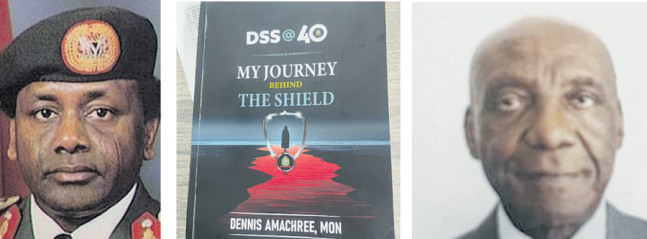
NewsOnline Nigeria reports that a retired Assistant Director of the Department of State Services (DSS), Dennis Amachree, has claimed that former military Head of State, Gen. Sani Abacha, died from a cardiac arrest during an intimate encounter with a woman at the Presidential Villa in Abuja.
Amachree made the revelation in his newly released 348-page memoir, DSS @40: My Journey Behind the Shield, where he sought to challenge decades of speculation surrounding the sudden death of the late military ruler.
ALSO: Court Sentences Three Oyo School Kidnap Suspects to Life Imprisonment for Terrorism Links
According to the former intelligence officer, the woman, a pharmacist, allegedly told him during an interrogation: “I did not kill him, he died on top of me.”
Abacha, who ruled Nigeria from November 1993 until his death on June 8, 1998, died at the age of 54 under circumstances that have remained the subject of controversy for nearly three decades.
Amachree’s account of Abacha’s final hours
Amachree, who served as Assistant Director of Operations and Intelligence at the Lagos State DSS Command at the time, claimed Abacha died at about 4:05 a.m. on June 8, 1998, after suffering what he described as a coitus-induced cardiac arrest.
According to the memoir, Abacha’s girlfriend allegedly visited him at the Aso Rock Guest House alongside her younger sister, a pharmacist who was in Abuja for a conference.
The retired DSS officer claimed that after the girlfriend returned to her hotel, the pharmacist remained with the Head of State.
He wrote that during an intimate encounter, the woman noticed Abacha had become unresponsive and, after confirming he had no pulse, fled the villa in panic.
Amachree alleged that the woman later travelled to Lagos on an early morning flight before security agencies could question her.
‘He died on top of me’
The retired DSS officer said he received instructions from the DSS headquarters to locate and interrogate the woman in Lagos.
According to him, the pharmacist’s first words during the interrogation were:
“I did not kill him, he died on top of me.”
Amachree said after taking her statement, he immediately informed DSS headquarters, after which she was flown back to Abuja.
Rejects conspiracy theories
The former intelligence officer dismissed several long-standing theories surrounding Abacha’s death, including claims involving poisoned apples, imported prostitutes, Viagra use, and foreign intelligence agencies.
He argued that the pharmacist’s account remains the most accurate explanation of the events leading to the former military ruler’s death.
According to Amachree, many public accounts over the years have been based on speculation rather than verifiable facts.
He also disputed narratives previously advanced by former Chief Security Officer Major Hamza Al-Mustapha, former Minister Gen. Jeremiah Useni, former National Security Adviser Susan Rice, retired military doctor Brig.-Gen. Oviemo Ovadje, former Aviation Minister Femi Fani-Kayode, and other commentators.
Abacha’s legacy
Amachree described Abacha’s five-year military rule as a period marked by authoritarianism, widespread human rights abuses, arbitrary arrests, torture, and political repression.
He noted that Abacha had begun plans to transform himself from military ruler to civilian president before his sudden death, having secured endorsements from the five registered political parties at the time.
The retired DSS officer said his memoir was intended to preserve what he described as the true account of one of Nigeria’s most controversial moments in political history, insisting that “power is transient” and that history should be guided by facts rather than speculation.