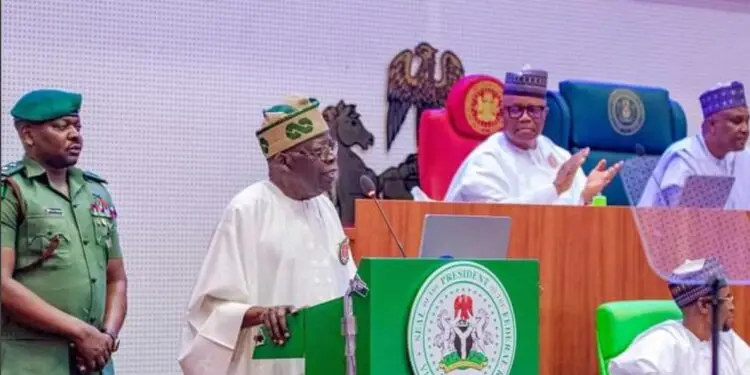
President Tinubu Government’s $750m World Bank Loan is reportedly tied to new taxes, electronic transfer levy, and green tax reforms.
Fresh details have revealed that key tax and revenue measures introduced under the administration of President Bola Tinubu formed part of the reform commitments attached to a $750 million World Bank loan secured by the Federal Government.
The loan, approved by the World Bank on June 14, 2024, was signed five days later under the Accelerating Resource Mobilisation Reforms (ARMOR) Program-for-Results initiative designed to strengthen Nigeria’s domestic revenue generation.
ALSO: Peter Obi Asks Tinubu to Resign or Drop 2027 Re-election Bid Over Rising Insecurity
Programme documents reviewed by SaharaReporters indicate that the Federal Government has so far accessed $280.551 million of the approved facility.
The documents further show that cumulative disbursements are projected to reach $343 million by the end of 2026, while the full $750 million is expected to be released by 2028, subject to the implementation of agreed reform milestones.
A major component of the programme focuses on increasing Nigeria’s tax revenue through the introduction and expansion of various taxes and levies.
According to details published on the World Bank’s programme page, the ARMOR initiative includes revenue policy measures such as increasing health-related taxes on tobacco and alcohol products, introducing taxes on online betting and gambling, imposing new excise duties on telecommunications services, implementing green taxes on vehicles and single-use plastics, and enforcing an electronic money transfer levy.
The electronic money transfer levy later became one of the first measures implemented under the programme.
Barely three months after Nigeria signed the loan agreement, fintech company OPay informed customers that it would begin charging a one-time ₦50 fee on electronic transfers of ₦10,000 and above into personal and business accounts.
The company explained in a notice that the charge, which took effect on September 9, 2024, was introduced in compliance with regulations issued by the Federal Inland Revenue Service (FIRS) and stressed that the proceeds belonged entirely to the Federal Government.
“It is important to note that OPay does not benefit from these charges in any way as it is directed entirely to the federal government,” the company said in the customer notice.
The levy was subsequently expanded across the banking industry.
From January 1, 2026, commercial banks and other financial institutions began applying the ₦50 Electronic Money Transfer Levy (EMTL) on electronic receipts or transfers of ₦10,000 and above, following the implementation of the new Tax Act.
The EMTL, commonly referred to as stamp duty on electronic transfers, is a one-off charge applicable to qualifying transactions received into bank accounts.
The Tinubu administration also moved ahead with another key commitment under the World Bank-backed programme by introducing new environmental tax measures.
In April 2026, the Federal Government announced a green tax surcharge on motor vehicles as part of its 2026 fiscal policy package, with implementation commencing on July 1, 2026.
According to Reuters, the surcharge applies a 2% levy on vehicles with engine capacities ranging from 2,000cc to 3,999cc, while vehicles with engines of 4,000cc and above attract a 4% levy.
The government said the measure forms part of a broader package of fiscal reforms that also includes revised import tariffs, adjustments to excise duties and the implementation of the ECOWAS Common External Tariff.
The Tinubu administration has faced criticism from sections of the public over the introduction of new taxes and levies amid rising living costs.
However, the government has consistently defended the reforms, maintaining that they are necessary to improve domestic revenue mobilisation, strengthen public finances and support Nigeria’s long-term economic development.