Executive remuneration at some of Nigeria’s major banks increased significantly faster than earnings in 2025, with the highest-paid directors at Zenith Bank, First HoldCo and Access Holdings recording substantial pay increases despite varying profit performances.
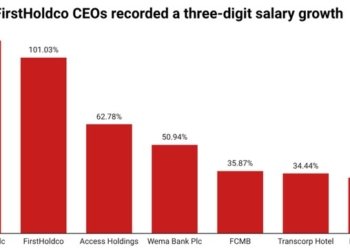
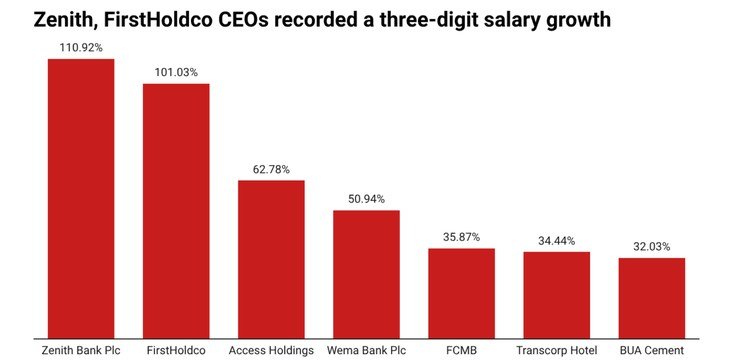
Audited financial statements show that remuneration for Zenith Bank’s highest-paid director rose by 110.9 per cent to ₦367 million in 2025, from ₦174 million in 2024.
At First HoldCo, the remuneration of its highest-paid director increased by 101 per cent to ₦195 million, from ₦97 million a year earlier.
The increases contrast with the banks’ respective profit performances and highlight the growing gap between executive compensation and earnings attributable to shareholders in parts of Nigeria’s banking industry.
At Zenith Bank, gross earnings increased 5.6 per cent to ₦4.19 trillion in 2025 from ₦3.97 trillion, while profit after tax edged up only slightly to ₦1.04 trillion from ₦1.03 trillion.
The bank’s highest-paid director, however, saw remuneration more than double during the same period.
The growth in pay was therefore more than 100 percentage points higher than the approximately 0.7 per cent increase in profit after tax.
Zenith’s profit before tax also declined by 4.8 per cent to ₦1.26 trillion during the year.
The bank’s broader executive compensation increased to approximately ₦5.88 billion in 2025 from ₦3.78 billion, while total directors’ remuneration, excluding pension and certain benefits, rose to about ₦6.50 billion from ₦4.19 billion.
Despite the sharp increase in executive remuneration, Zenith’s earnings per share fell to ₦25.32 from ₦32.87, according to its financial statements. The decline in EPS reflects, among other factors, the expansion of the bank’s share base following its capital-raising activities.
First HoldCo recorded an even wider divergence between executive pay and profitability.
The group’s gross earnings rose 6.9 per cent to ₦3.44 trillion from ₦3.21 trillion, while net interest income increased 36.8 per cent to ₦1.92 trillion.
However, profit before tax declined by 70.5 per cent to ₦235 billion, while profit for the year plunged 79.4 per cent to ₦139.5 billion.
The decline was driven largely by higher impairment charges and operating expenses.
Impairment charges on financial instruments increased 93.8 per cent to ₦826.3 billion, while operating expenses rose 32.1 per cent to ₦1.23 trillion.
Against that backdrop, remuneration for First HoldCo’s highest-paid director doubled to ₦195 million.
The group’s 2025 accounts also show total directors’ emoluments rising to ₦992 million from ₦936 million. Executive compensation increased to ₦294 million from ₦159 million.
Key management compensation, covering executive directors and members of the management committee, also increased significantly to ₦8.92 billion from ₦4.76 billion.
Salaries and other short-term employee benefits rose to ₦8.41 billion from ₦4.46 billion.
The figures indicate that executive compensation does not necessarily move in direct proportion to annual profit, as remuneration may also reflect executive responsibilities, incentive structures and broader performance measures.
The pattern also extended to Access Holdings, although the divergence was less pronounced than at First HoldCo.
The remuneration of Access Holdings’ highest-paid director increased 62.8 per cent to ₦293 million from ₦180 million.
During the same period, the group’s gross earnings increased 13.3 per cent to approximately ₦5.53 trillion, while profit before tax rose 16.2 per cent to ₦1.01 trillion.
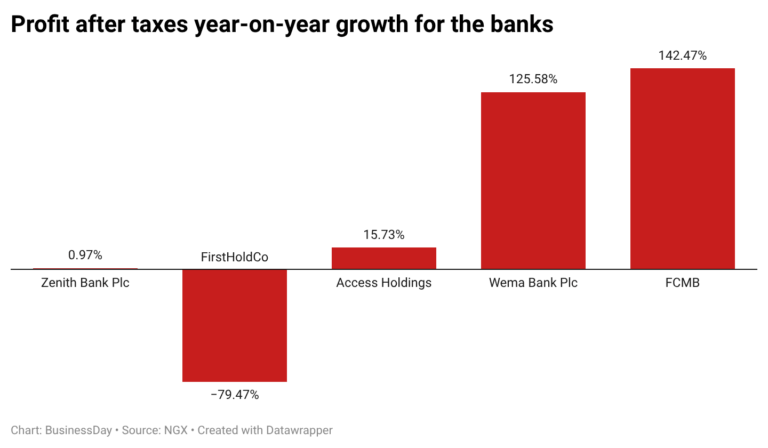
Profit after tax increased 15.7 per cent to ₦743.1 billion.
The increase in the highest-paid director’s remuneration was therefore substantially higher than the growth in profit after tax.
Access Holdings also experienced higher credit costs during the year, with impairment charges increasing by more than 100 per cent, highlighting the asset-quality pressures faced by banks despite continued growth in income and profitability.
The relationship between executive remuneration and earnings was different at Wema Bank.
Wema’s highest-paid director received ₦160.3 million in 2025, representing an increase of about 50 per cent from ₦106.9 million in 2024.
However, the bank’s profit before tax increased by approximately 116 per cent to ₦221.9 billion, from ₦102.5 billion.
Gross earnings rose 52.8 per cent to ₦660.6 billion, while net interest income more than doubled to ₦361 billion.
Wema’s total directors’ remuneration increased to ₦915.5 million from ₦728.2 million.
At FCMB Group, the highest-paid director received ₦447.9 million in 2025, up 35.9 per cent from ₦329.5 million.
The figure represented the highest absolute remuneration among the five institutions considered.
However, FCMB’s profit before tax increased by 80.6 per cent to ₦202.1 billion, while profit after tax more than doubled to ₦177.3 billion.
The group’s total directors’ remuneration increased to ₦5.75 billion from ₦3.51 billion.
The comparison shows different relationships between executive pay and profitability across the banks.
At Zenith, First HoldCo and Access Holdings, remuneration for the highest-paid director grew faster than profit after tax. At Wema and FCMB, however, profit growth outpaced the increase in remuneration for the highest-paid director.
The figures do not, by themselves, establish whether executive remuneration was excessive or unrelated to performance. Rather, they provide investors with another measure for assessing how banks structure compensation alongside profitability, capital requirements, asset quality and shareholder returns.
The remuneration trends also come as Nigerian banks operate amid significant changes in the industry, including the Central Bank of Nigeria’s recapitalisation programme, which ran from March 2024 to March 2026.
The recapitalisation exercise required banks to strengthen their capital bases amid inflation, currency volatility, elevated credit risks and changing interest-rate conditions.
As banks expand their capital bases, investors are increasingly focused not only on headline profit but also on return on equity, earnings per share, asset quality, cost efficiency and the sustainability of earnings.
Currency movements have also affected the sector through foreign-exchange revaluation, the translation of foreign-currency assets and liabilities and the capacity of borrowers with foreign-currency obligations to service their debts.
The experience of First HoldCo and Access Holdings illustrates the distinction between revenue growth and bottom-line performance, as higher income can be accompanied by significant increases in impairment charges and other costs.
For investors, the 2025 remuneration figures therefore offer a broader lens through which to examine executive compensation and financial performance across Nigeria’s banking sector, rather than relying solely on the absolute amount paid to individual directors.