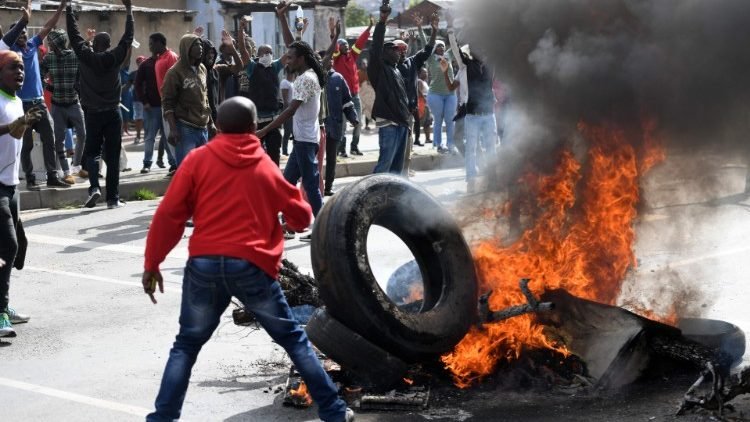
South Africa is currently on the edge as nationwide anti-migrant protests spark fears of xenophobic violence.
NewsOnline Nigeria reports that an atmosphere of uncertainty and fear gripped several communities across South Africa on Monday ahead of nationwide anti-migrant protests, with authorities warning against violence as thousands of foreign nationals prepared for possible unrest.
The demonstrations, organised by anti-migrant groups, coincide with a June 30 deadline they set for undocumented immigrants to leave the country, following weeks of protests, intimidation and attacks targeting foreign nationals.
Although President Cyril Ramaphosa’s administration has appealed to protesters to exercise their constitutional rights peacefully, thousands of migrants remain stranded in temporary camps, while many others have chosen to leave South Africa through voluntary repatriation programmes.
ALSO: Tinubu Approves Major NYSC Reforms, Replaces Passing Out Parade With Graduation Ceremony
Several African countries, including Nigeria, Zimbabwe, Mozambique, Ghana, Kenya, Malawi and the Democratic Republic of Congo, have begun evacuating citizens who no longer feel safe remaining in South Africa.
Nigeria has already repatriated 324 citizens through two official evacuation flights under an emergency voluntary return programme.
Official estimates place the documented Nigerian population in South Africa at between 25,000 and 35,000 people.
Many migrants say growing threats and hostility forced them to abandon their homes and livelihoods.
One migrant said he decided to leave after neighbours repeatedly warned that foreigners would be attacked once the June 30 deadline expired.
“That’s why today I decided to join our brothers and go home,” he said.
Another migrant disclosed that he was forced to leave his children behind with his South African wife after she informed him she could no longer support the family alone.
The protests follow reports that at least three migrants—two Mozambicans and one Malawian—have been killed in recent weeks, further heightening fears of xenophobic violence.
In response, South African authorities have increased security across the country, warning that anyone attempting to incite violence or take the law into their own hands will be arrested.
Police and private security agencies have identified Gauteng, KwaZulu-Natal, the Western Cape and the Eastern Cape as potential flashpoints.
In a statement issued on Sunday, President Ramaphosa acknowledged that peaceful protest is protected under South Africa’s Constitution but stressed that intimidation, threats and violence would not be tolerated.
“The right to protest and freedom of expression does not allow people to threaten or intimidate others, or to engage in acts of vandalism or violence,” he said.
Ramaphosa reaffirmed that South Africa remains a constitutional democracy governed by the rule of law and reminded citizens that many foreign nationals live and work legally in the country.
“Some foreign nationals who live in South Africa are here lawfully. They work, study, raise families, invest in our economy, and contribute positively to our society. They, too, are entitled to the protection of our laws and our Constitution,” the President stated.
He also welcomed assurances from some protest organisers that demonstrations would remain peaceful, warning that they would be held accountable should violence occur.
Despite the government’s appeal, many businesses planned to close temporarily over fears that protests could disrupt commercial activities.
However, business groups and labour unions rejected claims that migrants are responsible for South Africa’s economic challenges.
A coalition within the National Economic Development and Labour Council (NEDLAC), comprising COSATU, FEDUSA, SAFTU and NACTU, argued that unemployment, poverty, corruption, economic stagnation and weak governance—not migrants—are the real causes of the country’s economic difficulties.
“Removing foreign nationals from workplaces, communities, or public spaces will not reopen factories or create sustainable jobs,” the coalition said, urging authorities to focus on addressing the country’s underlying economic problems.
The organisations also warned that rising anti-migrant rhetoric risks deepening social divisions while distracting attention from longstanding governance failures.
Business chambers, including the Johannesburg Chamber of Commerce and Industry and the Pietermaritzburg Chamber of Business, stopped short of advising members to shut down but recommended avoiding unnecessary travel, particularly in areas identified as protest hotspots.
Meanwhile, thousands of migrants continued waiting in makeshift camps for transportation back to their home countries.
At a temporary camp near Durban, 28-year-old Wilson Petro expressed relief at finally leaving after days of uncertainty.
“We are here because we have been struggling as foreigners. Today we will be leaving this camp and going to Limpopo and then, hopefully, to Malawi,” he said.
Nearby, families lived under difficult conditions, with clothes hanging from perimeter fences while parents and children waited anxiously for evacuation.
At the Che Guevara Home Affairs office, asylum seeker Salima Tusame said she had spent nearly five weeks trying to resolve her immigration status despite possessing valid documentation.
“I came to South Africa in 2015, and I have been at this Home Affairs for five weeks because of the march. I know I have papers which allow me to stay in South Africa, but they don’t care whether you have papers or not,” she said.
Tusame alleged she had experienced verbal and physical abuse and could no longer continue her fruit-selling business due to growing hostility toward foreigners.
“I don’t know what will happen with the planned protests tomorrow,” she added.
KwaZulu-Natal Premier Thami Ntuli also appealed for calm, warning against a repeat of the destructive unrest that engulfed the province in July 2021.
“July 2021 set us back years; we have not yet fully recovered. That is the price chaos extracted from this province,” Ntuli said.
“We buried that pain once. We will not dig that grave again—not for unrest, and not for hatred dressed up as protest.”
As South Africa entered a day of nationwide demonstrations, security agencies remained on high alert amid growing concerns that the protests could escalate into another wave of xenophobic violence if not properly contained.