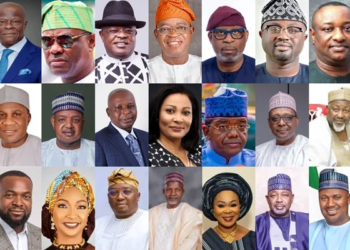
Ministers and political appointees are reportedly weighing their options as Tinubu’s resignation directive has sparked uncertainty.
As preparations gradually begin for the 2027 Nigerian General Elections, fresh political calculations are unfolding within the administration of Bola Ahmed Tinubu, with several ministers and political appointees reportedly reconsidering their political ambitions amid growing uncertainty.
Insiders within the ruling All Progressives Congress (APC) indicate that some political office holders who had earlier nursed plans to contest elective positions in 2027 are now reluctant to resign their current appointments. The hesitation follows the president’s directive requiring appointees seeking elective offices to step down from their positions ahead of party primaries.
The directive, issued through the office of George Akume, Secretary to the Government of the Federation, requires all political appointees intending to contest in the next election cycle to resign on or before March 31, 2026. The order aligns with Section 88(1) of the Electoral Act 2026 and the timetable released by the Independent National Electoral Commission (INEC) for party primaries.
ALSO: President Tinubu Moves to Cushion Fuel Price Impact On Nigerians
Those affected by the directive include Ministers, Ministers of State, Special Advisers, Senior Special Assistants, Special Assistants, Personal Assistants to the President, as well as Directors-General and Chief Executive Officers of federal government agencies and parastatals.
However, reports suggest that many appointees are carefully weighing their options before making a final decision, particularly due to uncertainties surrounding party nominations and the influence of state governors within the APC.
Sources familiar with the situation say the political climate has created apprehension among some aspirants who fear they may not secure the party ticket even if they resign their positions.
One APC member, who spoke on condition of anonymity, said the growing alignment between state governors and the presidency has significantly altered the political equation within the party.
“With the way governors are aligning with the President, there is a strong possibility that they may have a major say in determining who gets the party ticket in their states. Those tickets could become bargaining chips in broader political negotiations,” the source said.
The concerns are reportedly heightened by speculation that informal understandings may exist between the presidency and some governors regarding political succession arrangements within their states.
Some political observers believe that many appointees are now adopting a cautious approach, preferring to retain their current positions rather than risk resigning without firm assurances of securing party nominations.
A minister who had earlier expressed interest in contesting, speaking confidentially, noted that governors currently wield significant influence over party structures within their states.
“The governors hold the structures and the decision-making power. In many cases, they determine who emerges as candidates,” the minister said, adding that many governors prefer trusted allies to succeed them in office.
The political dynamics have also been shaped by the recent influx of opposition governors into the APC, which has expanded the party’s influence across many states. Analysts say the growing dominance of the ruling party may further limit political options for aspirants seeking alternative platforms.
Currently, only a few states such as Oyo State, Osun State, and Abia State remain outside the APC’s control at the gubernatorial level.
Political analysts suggest that the evolving landscape could strengthen the influence of governors in determining candidates for key elective positions.
Commenting on the development, Abubakar Kari, a professor of sociology at the University of Abuja, said the situation reflects broader structural issues within Nigeria’s political system.
“By their design, the current political arrangements give significant power to governors. That is partly why many political actors are aligning with the APC,” Kari said.
He warned that weakening democratic institutions could gradually create conditions that resemble a dominant-party system.
Similarly, Ibrahim Tahir, a former chairman of the People’s Democratic Party (PDP) in Adamawa State, described the situation as particularly challenging for political appointees considering electoral ambitions.
“It would be risky for anyone to resign now without a strong assurance of securing the party ticket,” he said.
According to Tahir, the limited strength of opposition parties in the current political environment means that aspirants who lose out in the APC primaries may struggle to find viable alternative platforms.
As the 2027 election cycle gradually approaches, the unfolding developments highlight the complex calculations facing political office holders, balancing ambition with political realities in an increasingly competitive and centralized party structure.