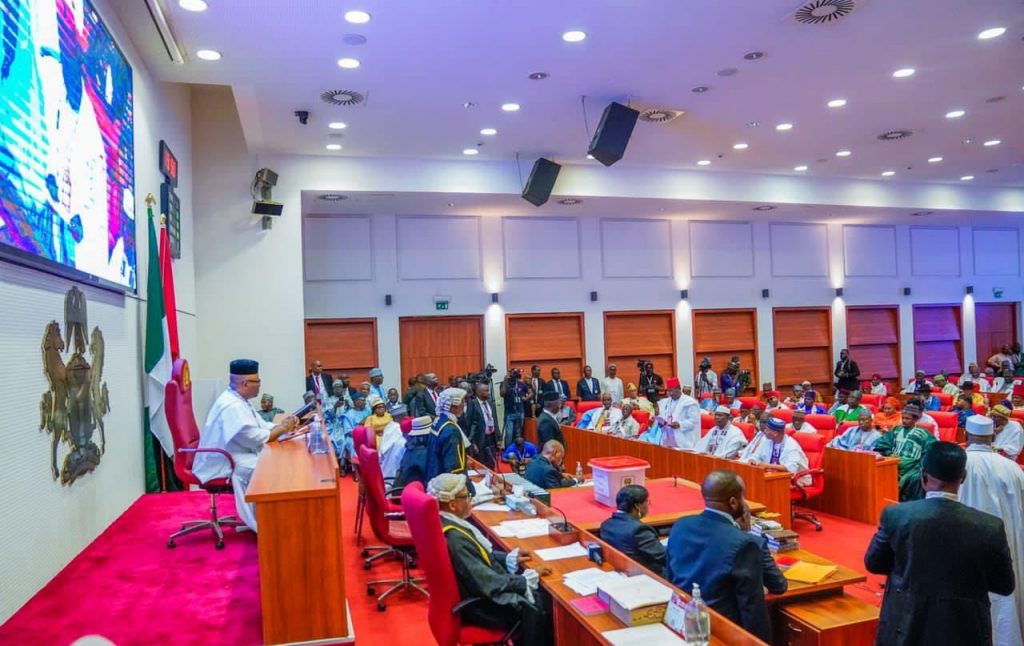
When the Senate passed the 2022 Amendment Act Bill recently, many Nigerians, political activists, CSO and opposition politicians expected it to close the various gaps exposed in the 2023 general elections.
Many Nigerians earnestly look forward to a major reform of the electoral act to a legal backing for “real time” transmission of results but the Upper legislative chamber rejected “realtime” transmission of election results thereby extinguishing the expectations of the Nigerian people and accountability framework.
This rejection by the Senate caused a public uproar, outrage and reopen distrust, transparency and credibility of future elections. Critics and opposition political parties cried foul saying something fundamental has been lost to election riggers and corruption as the chance to make transparency compulsory has been compromised.
ALSO: INEC Proposes N873.78bn Budget for 2027 General Elections, Seeks N171bn for 2026 Operations
The question now is why is electronic transmission of election results, a big issue in Nigeria? For years, Nigeria’s election are often marred by allegations of malpractices, riggings and manipulations during collation of results. After peaceful elections, disputes often arise when election results are moved from one collation centre to another. So as a way of addressing these anomalies, the Independent National Electoral Commission ( INEC) introduced the BVAS and IReV ahead of 2023 elections. The aim of these innovations was to ensure that once results are counted and signed at the polling units, they should be uploaded online for everyone to see. This according to INEC would reduce human interference, improve transparency, credibility and allow citizens to independently cross check results irrespective of their locations.
However, because these INEC tools were not backed by the law, their use remain discretionary because this lack of legal backing was a major problem in 2023. This amendment of the 2022 electoral act by the Senate intends to make electronic transmission compulsory ensuring “realtime” linked directly to the IReV which would have election results transmission from a discretionary exercise into a legal framework. But instead of doing this, the Senate rejected section 60(3) of the 2022 electoral act which is at the centre of controversy and adopted section 60(5). Thus the version adopted leaves everything to the discretion of the electoral umpire.
However, in its defence, the Upper legislative chamber says electronic transmission of results in “realtime” does not translate to e-voting as being peddled in some quarters adding that the Independent National Electoral Commission, (INEC) currently lack the capacity to conduct e-voting. It also clarifies that the INEC IReV is not an an e-voting platform, but a platform for election results that have been manually counted and declared at the polling units and are uploaded and published.
According to the Chairman, Senate Ad-Hoc Panel to review the 2026 electoral bill, Adeniyi Adegbonmire, explained the difference between the electronic transmission of election results in realtime and the e-voting system. The IReV is not a voting platform rather it is a platform meant to publicized election results already declared by the presiding officers at the polling unit across the federation.
Meanwhile, Nigerian are calling for the adoption of the House Representatives version of the 2026 electoral bill which provided for electronic transmission of election results realtime. Now that a panel has been set to harmonize the senate position with that of the House of Representatives, Nigerian are anxiously waiting that the will of the people will prevail.