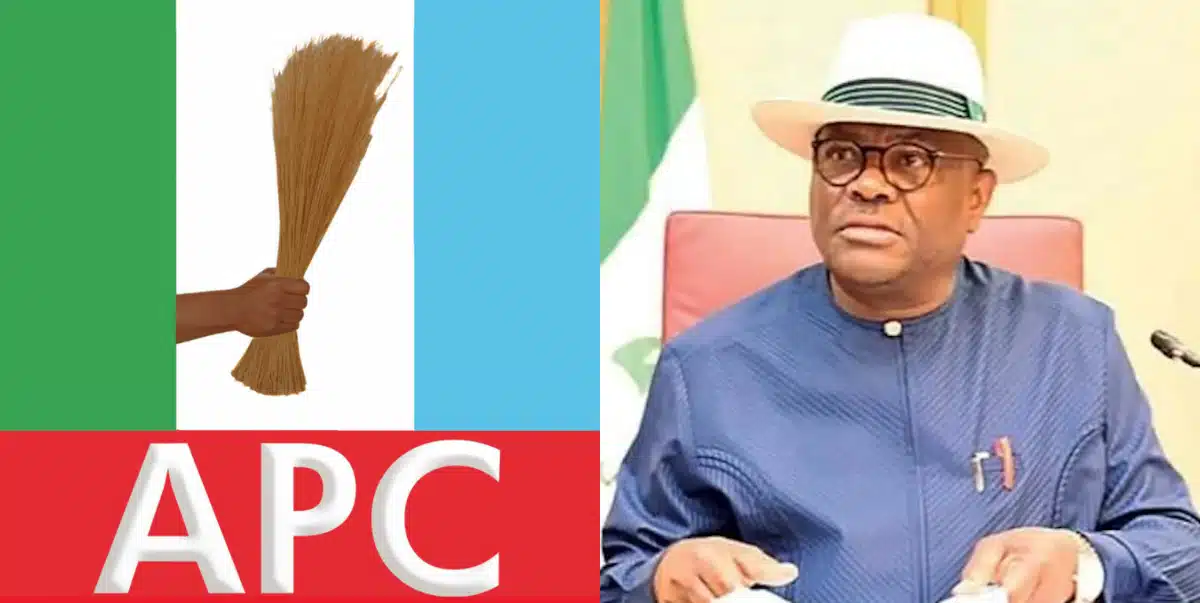
Wike-APC Governors rift has raised fresh loyalty test for Tinubu.
NewsOnline Nigeria reports that the escalating disagreement between Minister of the Federal Capital Territory (FCT), Nyesom Wike, and governors elected on the platform of the All Progressives Congress (APC) is creating a fresh test of political loyalty and campaign coordination for President Bola Tinubu ahead of the 2027 general elections.
The dispute centres on Wike’s Rainbow Coalition, a cross-party political platform he says is designed specifically to mobilise support for Tinubu’s re-election while allowing political parties to maintain their identities and field candidates in other contests.
ALSO: Otedola’s Fortune Hits $2bn as FirstHoldCo Rally Narrows Gap with Africa’s Richest
APC governors, however, have drawn a clear line, insisting that their campaign commitment is to APC candidates at all levels and that they will not support political arrangements that could weaken the party or its candidates.
The positions have created an unusual political situation in which Wike, a member of the opposition Peoples Democratic Party (PDP) and a minister in the APC-led Federal Government, is campaigning for the re-election of an APC president while maintaining that the PDP and other parties should remain free to contest governorship and legislative elections.
Wike separates Tinubu support from APC loyalty
Wike has repeatedly maintained that his support for Tinubu should not be interpreted as support for the APC or its candidates in other elections.
In his latest response to the governors, Wike said the Rainbow Coalition had “nothing to do with APC” and was instead intended to mobilise support across political parties for Tinubu.
He also said he had never promised that the PDP would refrain from fielding candidates in governorship, National Assembly and state House of Assembly elections.
“What I said and stand for is that I will mobilise support for the re-election of Tinubu. I never promised anyone that PDP will not field candidates,” Wike said.
The minister has argued that Nigerian voters can support different parties in presidential and sub-national elections, citing voting patterns from the 2023 elections in states including Imo, Abia, Enugu and Ebonyi.
Wike’s position effectively separates loyalty to the President’s presidential ticket from loyalty to the APC’s candidates in other contests.
APC governors draw the line
The APC governors have adopted a different position.
Hope Uzodimma, Imo State governor and chairman of the Progressive Governors Forum, said after the governors’ meeting in Abuja that the forum would not support any alliance capable of undermining Tinubu’s re-election, weakening the APC or adversely affecting its candidates.
Uzodimma further stated that APC governors would not support non-APC candidates in the 2027 elections.
“The APC Governors Forum unanimously resolved that its members will not participate in, support or endorse any alliance or political arrangement capable of undermining the re-election of Mr President, weakening the APC or adversely affecting any candidate of the party at all levels,” he said.
The governor added that the party’s campaign architecture would align with Tinubu’s agenda and the interests of APC candidates.
That position puts the governors and Wike at odds over a fundamental question: whether support for Tinubu can be separated from support for the APC’s broader electoral interests.
Rift puts Tinubu in a delicate political position
The disagreement does not amount to a dispute over whether Wike supports Tinubu. Wike has been explicit about his backing for the President’s second-term bid.
The issue is instead how that support should be organised and whether the President’s supporters outside the APC should operate independently of the party’s formal campaign machinery.
The Guardian reported that the confrontation has raised questions about control of the political machinery for Tinubu’s 2027 campaign, with Wike insisting that his coalition is separate from the APC while governors seek to protect the party’s structure and candidates.
For Tinubu, the competing positions create a political balancing exercise. The President has both the formal APC structure, including the governors, and politicians such as Wike who are supporting his re-election from outside the party.
An APC presidential campaign spokesperson, Ima Niboro, has described the disagreement as a dispute between political allies and urged Wike and the governors to stop their public exchanges and concentrate on mobilising voters for Tinubu.
Wike challenges governors over their political record
The disagreement has also become increasingly personal, with Wike questioning the ability of some APC governors to deliver presidential votes in their states.
He has specifically challenged the political record of Uzodimma, pointing to the difference between APC’s performance in some legislative contests and Tinubu’s presidential result in Imo in 2023.
Wike has also accused Uzodimma and Kwara State Governor AbdulRahman AbdulRazaq of working against his political activities, allegations the governors have not accepted as a basis for the dispute.
The rhetoric escalated further after Wike described the governors opposing his coalition as “politically lazy” during an Arise TV interview.
He nevertheless reiterated that his support for Tinubu remained unchanged.
“I have said I will support the President and I am still supporting him. What has that got to do with my party?” Wike said.
Supporters push competing positions
The disagreement has attracted interventions from politicians on both sides.
Former Director-General of the Voice of Nigeria and APC chieftain Osita Okechukwu has urged Tinubu to accommodate Wike’s Rainbow Coalition, arguing that it could provide additional political support for the President.
Okechukwu alleged that some APC governors lacked sufficient capacity to mobilise voters for Tinubu, although the claim is his political assessment rather than an independently established fact.
On the other side, APC members in the South-East have backed the governors and asked Wike to apologise for his comments about their political capacity.
The conflicting interventions illustrate the wider disagreement over whether Wike’s coalition should be treated as an additional support network for Tinubu or as a parallel political structure that could compete with the APC’s campaign machinery.
The loyalty question
At the centre of the dispute is therefore a complicated question of political loyalty.
Wike says his loyalty in the presidential contest is to Tinubu, while retaining his PDP identity and the freedom to support candidates outside the APC at other levels.
The APC governors, meanwhile, have tied their support for Tinubu to the party’s wider electoral structure, saying their campaign commitment covers APC candidates across the ballot.
Neither position necessarily means that either side opposes Tinubu’s re-election. Rather, the disagreement concerns the political machinery through which support for the President should be mobilised and how that support interacts with contests for governorship and legislative offices.
The APC has publicly maintained that there is no cause for alarm, while supporters of the Rainbow Coalition argue that its cross-party structure could broaden support for Tinubu.
As the 2027 election approaches, the ability of the President and the ruling party to manage these competing political networks will remain an important feature of the emerging campaign landscape. Current developments establish a clear disagreement between Wike and the APC governors, but they do not establish that the rift will determine the outcome of the 2027 election.