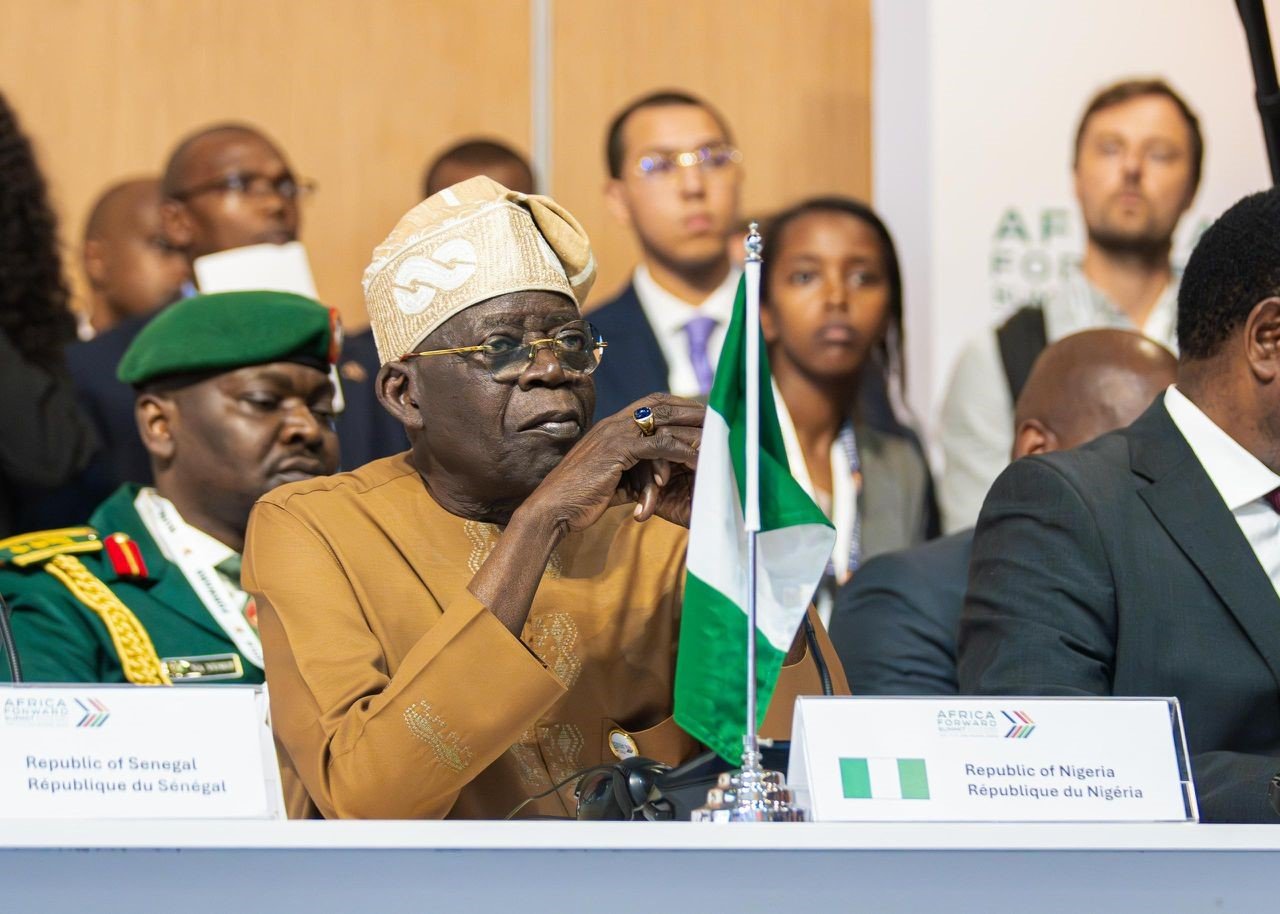
President Tinubu has demanded global financial reforms and claimed that Africa’s growth is being stifled.
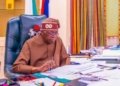
NewsOnline Nigeria reports that President Bola Tinubu has called for urgent reforms to the global financial system, warning that existing economic structures are hindering Africa’s industrialisation and long-term development.
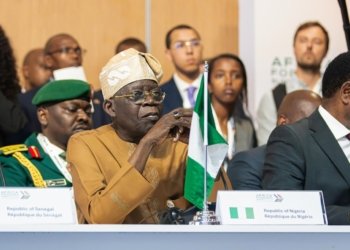
Tinubu made the call on Tuesday while addressing participants at the Africa Forward Summit held at the Kenyatta Convention Centre in Nairobi, Kenya.
The President led Nigeria’s delegation to the summit, which was co-hosted by Emmanuel Macron and William Ruto.
ALSO: 2027: NDC Fixes Presidential Nomination Form at N60m, Releases Primary Election Timetable
The event attracted leaders from over 30 countries, including António Guterres and Mahamoud Ali Youssouf.
In a statement issued by Tinubu’s Special Adviser on Information and Strategy, Bayo Onanuga, the President stressed that Africa must move beyond exporting raw materials and focus on industrialisation.
According to Tinubu, Africa’s share of global manufacturing value remains below two per cent despite decades of independence, blaming the situation on unfair global financial and trade systems.
“Last September, from the podium of the United Nations General Assembly, Nigeria warned that the international system must reform or risk irrelevance,” Tinubu said.
“We spoke not only of the Security Council but of the financial and trade structures that quietly de-industrialise our nations.”
The President highlighted Nigeria’s economic reforms, including fuel subsidy removal, exchange rate unification, and banking sector recapitalisation, describing them as necessary steps to stabilise the economy and attract investment.
However, he warned that rising debt servicing obligations continue to reduce fiscal space for development and industrial expansion.
Tinubu disclosed that Nigeria is projected to spend about $11.6 billion on debt servicing in 2026.
“Every single dollar that leaves our treasury to pay punitive interest rates is a dollar that did not go into our steel sector, our textile mills, our agro-processing plants, or our digital industries,” he said.
“It is a dollar that did not train a young Nigerian engineer or provide affordable power for our factories.”
The President insisted that Nigeria was not seeking charity but a fair global financial framework that would enable African nations to industrialise and compete globally.
Tinubu also pushed for stronger investment in Africa’s blue economy, pledging Nigeria’s support for regional maritime cooperation in the Gulf of Guinea through shared maritime intelligence infrastructure.
He added that secure maritime routes and improved governance are essential for unlocking the continent’s ocean economy potential.
On migration, Tinubu called for stronger global cooperation, noting that sustainable economic growth and job creation across Africa remain critical to reducing irregular migration.
On the sidelines of the summit, Tinubu held bilateral meetings with Madagascar’s President, Michael Randrianirina, and Patrice Motsepe, where he reaffirmed Nigeria’s readiness to host the 2026 CAF Awards.
The President was accompanied by top government officials and prominent Nigerian business leaders, including Aliko Dangote, Abdulsamad Rabiu, Tony Elumelu, and Aigboje Aig-Imoukhuede.