As Nigeria gradually inches toward the 2027 presidential election, one political reality is becoming increasingly difficult to ignore: the opposition may have handed President Bola Ahmed Tinubu an early strategic advantage long before the first ballot is cast.
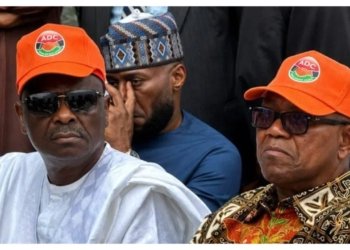
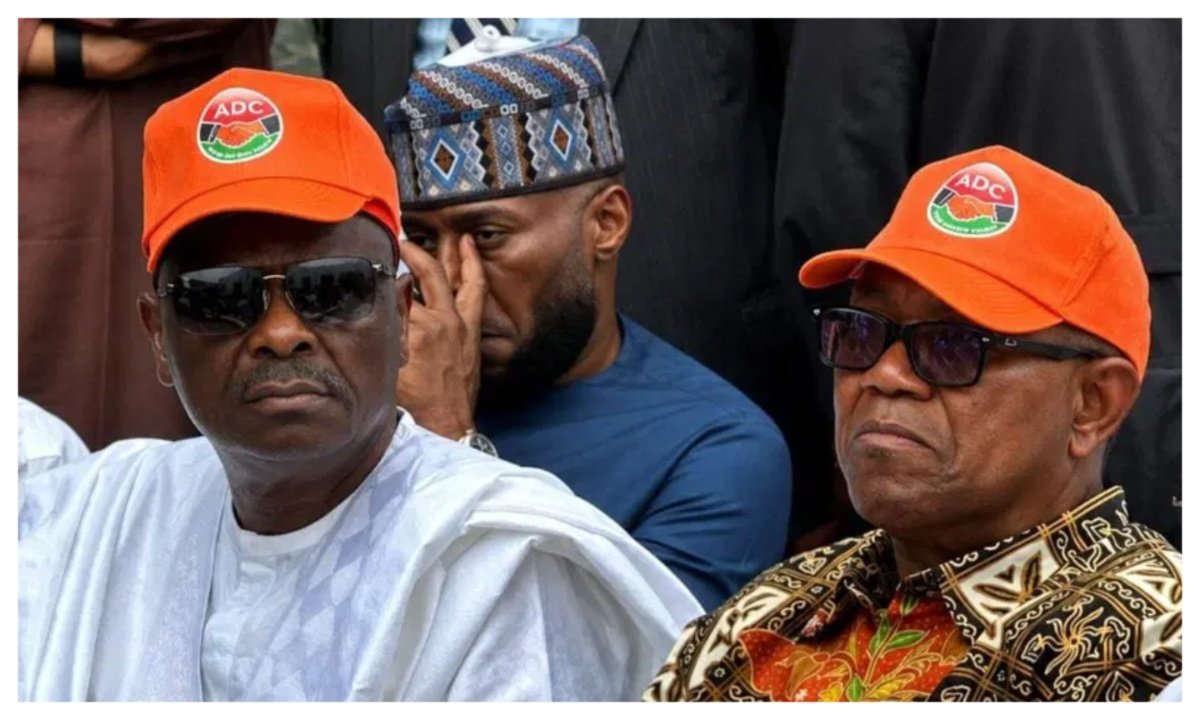
The decision by former Anambra State Governor Peter Obi and former Kano State Governor Rabiu Musa Kwankwaso to abandon the African Democratic Congress coalition project and align with the emerging Nigeria Democratic Congress (NDC) may have fundamentally reshaped the electoral landscape.
What once looked like a potentially formidable united opposition capable of confronting the ruling All Progressives Congress is now rapidly transforming into a fragmented three-way power struggle involving Tinubu, former Vice President Atiku Abubakar, and the Obi-Kwankwaso bloc.
ALSO: ‘No Comment’ – Rivers Governor Fubara Declines Media Questions After APC Screening
For the APC, this development could hardly have come at a better time.
The Coalition That Could Have Changed Everything
The original opposition coalition under the ADC had all the ingredients required to mount a serious national challenge.
Atiku brought his long-established dominance in the North-East and substantial influence across parts of Northern Nigeria. Obi arrived with perhaps the most passionate support base in modern Nigerian politics — especially among urban youths and the South-East. Kwankwaso, despite finishing fourth in 2023, controlled one of the most disciplined grassroots political structures in Kano through the Kwankwasiyya movement.
Together, the trio represented the closest possibility of recreating a broad anti-incumbent coalition capable of disrupting Tinubu’s nationwide political machinery.
But like many opposition coalitions in Nigeria’s history, ambition eventually collided with reality.
The unresolved battle over who should emerge as the coalition’s presidential candidate exposed deep cracks from the outset. Obi’s supporters believed his 2023 momentum and demographic appeal made him the strongest challenger to Tinubu. Atiku’s loyalists argued that the former vice president remained the opposition figure with the widest national spread and political experience.
The disagreement appears to have now shattered the coalition before it fully matured.
Obi Still Controls One of Nigeria’s Strongest Regional Voting Bases
The numbers from the 2023 presidential election remain revealing.
No candidate dominated any region the way Obi dominated the South-East. He secured nearly 90 percent of votes cast in the zone, an extraordinary political feat in Nigeria’s multiparty democracy.
Beyond the South-East, Obi also emerged strongly in the South-South, consolidating himself as the dominant opposition figure across much of Southern Nigeria.
That regional strength is politically significant because it gives any platform Obi joins instant national visibility and relevance.
However, the challenge for Obi remains the same challenge that haunted his 2023 campaign: converting Southern enthusiasm into broader Northern acceptance.
That is where Kwankwaso becomes strategically valuable.
Why Kwankwaso Remains a Major Political Asset
While critics often dismiss Kwankwaso because of his national ranking in 2023, such arguments ignore one crucial fact: Kano remains one of Nigeria’s most influential voting states.
Kwankwaso’s political strength is deeply rooted in Kano and parts of the North-West, where the Kwankwasiyya structure continues to command loyalty among grassroots voters.
For Obi, partnering with Kwankwaso potentially opens doors into Northern Muslim voting blocs that proved difficult to penetrate in the last election.
The alliance may not immediately transform the NDC into a national powerhouse, but it certainly gives Obi stronger Northern credibility than he possessed in 2023.
Still, major questions remain unanswered.
Can the Obi-Kwankwaso alliance expand beyond Kano and parts of the North-West? Can it attract establishment Northern politicians who still view Atiku as the more experienced national contender? And perhaps most importantly, can the alliance avoid the same internal contradictions that destroyed the ADC coalition?
Tinubu’s Biggest Strength Remains National Spread
Despite growing economic frustrations across the country, Tinubu enters the 2027 race with one major structural advantage his opponents still struggle to match: nationwide competitiveness.
Unlike Obi, whose support remains heavily concentrated in Southern urban centres, or Kwankwaso, whose strongest influence is largely Kano-based, Tinubu demonstrated in 2023 that he could remain electorally competitive across almost every geopolitical zone.
His dominance in the South-West remains intact, while the APC continues to maintain substantial political structures in the North-West and North-Central.
That national spread matters enormously in Nigeria’s presidential system, where victory depends not just on total votes, but also on geographical distribution across states and regions.
A fragmented opposition may once again allow the APC to secure pluralities across key battleground states without necessarily producing overwhelming national majorities.
Atiku May Be the Biggest Casualty of Opposition Division
Ironically, the politician most endangered by the collapse of opposition unity may be Atiku himself.
The former vice president still commands enormous influence in the North-East and maintains substantial political relationships across Northern Nigeria. Yet the collapse of the coalition significantly narrows his electoral path.
The original alliance would have given Atiku access to Obi’s youthful Southern base and Kwankwaso’s Kano structure — two critical assets that could have compensated for his declining influence in parts of Southern Nigeria.
Without them, Atiku risks becoming regionally strong but nationally constrained.
If the Obi-Kwankwaso alliance consolidates successfully under the NDC, anti-Tinubu votes could become dangerously divided between multiple opposition centres.
That scenario is precisely the type of political environment in which incumbents usually thrive.
The North May Decide 2027 Again
For all the excitement surrounding coalition politics, the electoral map still points to one uncomfortable truth: Northern Nigeria will likely remain the decisive battlefield in 2027.
Obi’s Southern popularity alone may not be enough to secure victory without deeper Northern penetration. Kwankwaso improves that equation, but not conclusively.
Atiku remains formidable in the North-East and retains strong Northern name recognition, meaning opposition votes in the region could split between both camps.
If that happens, Tinubu may once again emerge as the beneficiary of opposition fragmentation.
Opposition Ego May Ultimately Decide Tinubu’s Fate
Perhaps the most striking lesson from recent developments is that the opposition’s biggest obstacle may not be APC dominance, but its inability to build and sustain a united front.
History has repeatedly shown that Nigerian elections are rarely won by popularity alone. They are won through coalition-building, strategic compromise, regional balancing, and political discipline.
At the moment, the opposition appears to be struggling with all four.
Unless one bloc eventually collapses into another or a fresh consensus emerges, the 2027 election may no longer be a straightforward referendum on APC governance.
Instead, it risks becoming another contest where divided opposition ambitions inadvertently strengthen the incumbent president’s path to re-election.