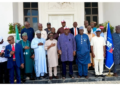
Nafiu Bala’s recent difficulty delivering a prepared speech has sparked conversation beyond a single awkward public moment. It highlights a deeper concern about the gradual decline of standards within Nigeria’s political environment. The issue is not about ridiculing an individual; rather, it raises important questions about a system that too often rewards mediocrity while overlooking competence.
Anyone aspiring to lead a major political party at the national level is expected to demonstrate clarity of thought, confidence, and intellectual readiness. Leadership in such positions is far from ceremonial. It requires strategic thinking, effective communication, and the capacity to inspire trust among party members and the wider public. When a leader struggles with even a prepared address, it naturally raises questions about readiness for the unscripted challenges that often define political leadership.
ALSO: Looting in Dollars, Paying in Naira: How Corruption Is Weakening Nigeria’s Currency By Festus Edovia
Nigeria cannot afford to normalize such moments as harmless missteps. Instead, they should prompt reflection on a broader pattern within the political landscape. Increasingly, political relevance appears to be shaped less by merit and capability and more by networks of loyalty, patronage, and political connections. In such an environment, competence risks becoming secondary while mediocrity is excused or sometimes even defended.
For many Nigerians, this trend fuels an uncomfortable concern: that the bar for leadership has been lowered to the point where almost anyone with the right backing can occupy influential positions. What may appear as a simple lapse today could translate into poor judgment or ineffective leadership when more consequential decisions must be made.
Nations rarely decline through a single dramatic failure. More often, the process is gradual, marked by a steady normalization of inadequacy and a slow erosion of institutional standards.
Yet the issue extends beyond any one individual. The deeper problem lies within the political ecosystem that produces and sustains such outcomes. Political parties are traditionally expected to act as gatekeepers of quality leadership, ensuring that those who rise through their ranks are prepared for the responsibilities ahead. In Nigeria, however, internal party democracy remains fragile, candidate selection processes are frequently contested, and mechanisms for accountability are often weak.
If Nigeria is to chart a different course, competence must become a non-negotiable standard in leadership selection. Citizens, civil society, and institutions must move beyond quiet frustration and consistently demand higher expectations from those seeking public office. Leadership, after all, shapes the direction of nations and the lives of millions.
If the current trajectory continues, the question may no longer be where the country is headed, but whether it is prepared to confront the consequences of repeatedly lowering the bar.
Written by Festus Edovia, ANIPR, FICM.