Several companies listed on the Nigerian Exchange (NGX) and international stock exchanges are facing significant legal battles in Nigeria, with disputes involving regulatory investigations, corporate acquisitions, taxation, telecommunications oversight and financial liabilities.
The cases, some of which are pending before the Federal High Court and Supreme Court, highlight the growing importance of judicial intervention in corporate governance, regulatory compliance and business operations across Nigeria’s economy.
For publicly traded companies, litigation can have far-reaching implications for financial performance, shareholder confidence, corporate restructuring and regulatory standing.
Findings reported by Nairametrics, based on court cause lists, legal practitioners and industry sources, indicate that several major companies are currently involved in civil and criminal proceedings that could influence their operations and business interests.
Nigeria’s legal framework provides multiple avenues for resolving corporate disputes, with the 1999 Constitution, as amended, serving as the country’s supreme law.
ALSO: Zenith Bank Celebrates Founder Jim Ovia at 75th Birthday and Retirement Dinner in Lagos
The Investments and Securities Act (ISA) 2025 provides a regulatory framework for capital market activities, including matters involving securities transactions, investments, corporate disclosures and investor protection.
The Securities and Exchange Commission (SEC), as Nigeria’s apex capital market regulator, oversees activities within its statutory jurisdiction while working alongside other agencies responsible for competition, taxation, banking and financial crime enforcement.
These agencies include the Economic and Financial Crimes Commission (EFCC), Federal Competition and Consumer Protection Commission (FCCPC), Nigeria Revenue Service (NRS) and other sector-specific regulators.
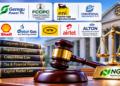
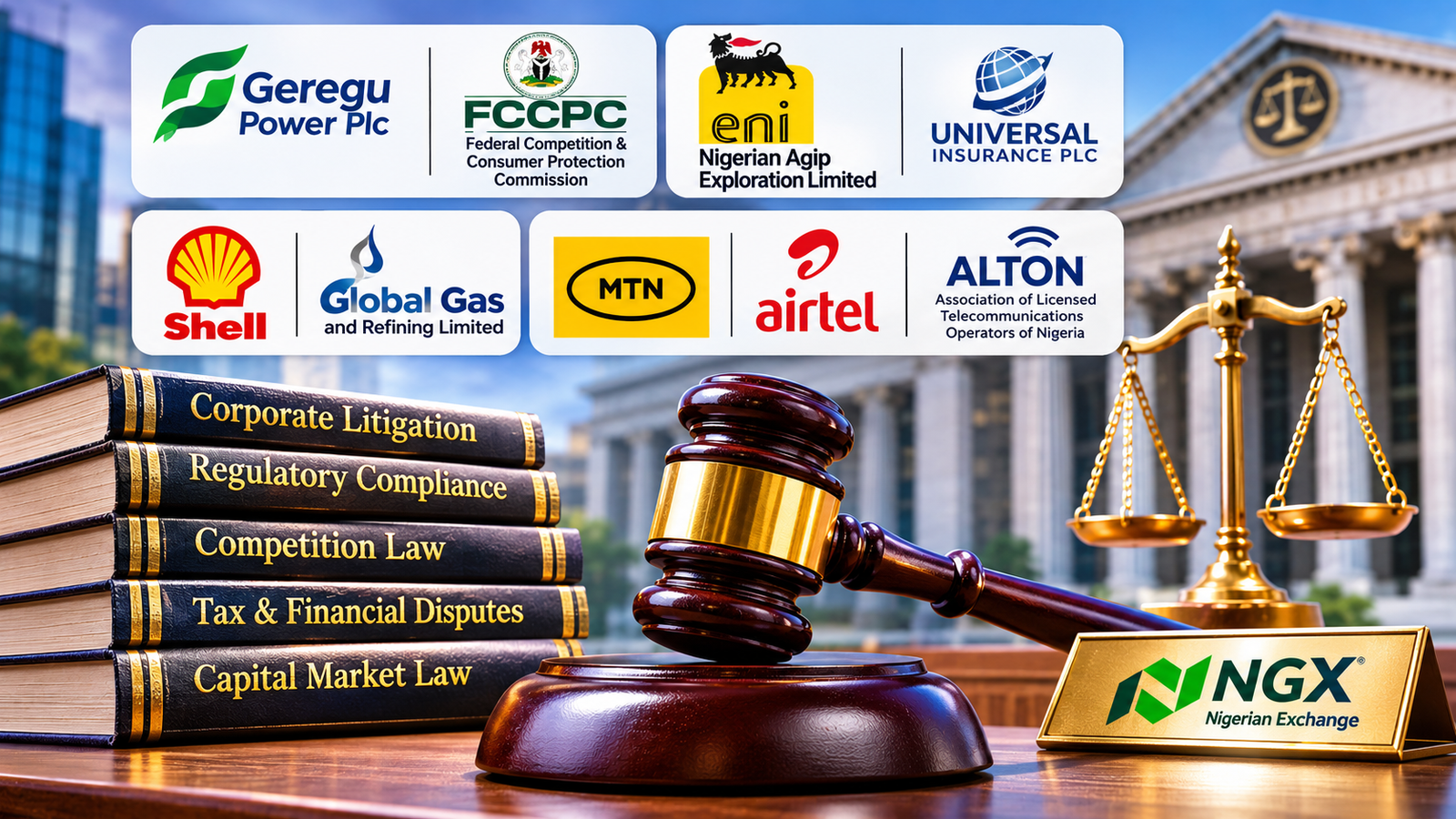
The disputes involving Geregu Power, Nigerian Agip Exploration, Universal Insurance, Shell and major telecommunications operators illustrate the range of legal challenges confronting corporate organisations.
Geregu Power Plc, one of Nigeria’s publicly listed power generation companies, is reportedly involved in a legal dispute with the Federal Competition and Consumer Protection Commission over a corporate acquisition.
According to Nairametrics, citing sources familiar with the matter, the FCCPC commenced an investigation into the indirect acquisition of Geregu Power by Ma’am Energy Limited.
The transaction reportedly involved Ma’am Energy’s acquisition of Amperion Energy from billionaire businessman Femi Otedola and other shareholders.
Following the commencement of the regulatory investigation, Geregu Power reportedly approached the Federal High Court seeking orders to restrain the FCCPC from proceeding with the probe, among other reliefs.
The dispute raises questions concerning competition regulation, corporate acquisitions and the extent of regulatory oversight over transactions involving publicly listed companies.
The case remains pending before the Federal High Court, with a hearing reportedly scheduled for December 2026.
In another significant corporate dispute, Nigerian Agip Exploration Limited and its Managing Director, Maurizio Pinna, are facing criminal proceedings initiated by the Nigeria Revenue Service over alleged tax evasion connected to Oil Mining Lease 125.
The Federal High Court in Abuja has reportedly fixed January 27, 2027, for the defendants’ arraignment.
According to the reported charge, the tax authority accused the oil company and its managing director of violating provisions of the Tax Administration Act 2025.
The defendants are expected to enter their pleas when the matter comes before the court.
Should the case proceed to trial, prosecutors would be required to establish the allegations through admissible evidence, while the defendants would have the opportunity to challenge the prosecution’s case.
The allegations remain unproven, and the defendants are entitled to the presumption of innocence.
The proceedings underscore the potential legal consequences of disputes over tax compliance in Nigeria’s oil and gas industry.
Meanwhile, Universal Insurance Plc is challenging the revocation of its operating licence by the National Insurance Commission (NAICOM).
A Federal High Court in Lagos reportedly extended an interim restraining order against NAICOM and the receiver appointed over the insurance company, pending the hearing of the substantive suit.
The development was disclosed in a corporate filing submitted to the Nigerian Exchange on September 4, 2026, and signed by the company’s secretary, Chinedu Onyilimba.
The litigation concerns the regulator’s decision to revoke the company’s operating licence and the subsequent steps taken in relation to its business.
The outcome could have implications for Universal Insurance’s operations, corporate status and shareholders.
The matter remains before the court, and the interim order does not constitute a final determination of the underlying dispute.
Another major legal battle involves Global Gas and Refining Limited and Shell Petroleum Development Company of Nigeria Limited, arising from a longstanding Gas Processing Agreement dated March 15, 2002.
The dispute is reportedly pending before the Supreme Court following years of legal proceedings.
The controversy gained renewed attention after Shell announced in March 2025 that it was proceeding with the sale of its Nigerian onshore subsidiary, Shell Petroleum Development Company of Nigeria Limited, to Renaissance.
Shell stated that the transaction had received the necessary approvals from the Federal Government.
However, Global Gas maintains that the transaction could affect its rights and interests under the existing gas processing agreement.
Shell, in its submissions before the Federal High Court, reportedly argued that the Renaissance transaction involved the sale of shares rather than a direct sale of the company’s assets.
The distinction between a share sale and an asset sale is central to the legal arguments surrounding the transaction and its potential implications for existing contractual obligations.
Although Shell Petroleum Development Company of Nigeria Limited is not listed on the Nigerian Exchange, its former parent, Shell plc, is publicly traded on international exchanges, including the London Stock Exchange, Euronext Amsterdam and the New York Stock Exchange.
The pending Supreme Court proceedings highlight the complexity of corporate transactions involving longstanding commercial agreements and ownership changes.
Nigeria’s telecommunications industry is also facing a significant legal dispute involving regulatory authority and legislative oversight.
On November 4, 2026, the Registered Trustees of the Association of Licensed Telecommunications Operators of Nigeria (ALTON), alongside MTN Nigeria Communications Plc, Airtel Networks Limited and other plaintiffs, reportedly instituted proceedings against the House of Representatives and other defendants before the Federal High Court in Abuja.
The plaintiffs are seeking judicial intervention over what they describe as interference with the statutory regulatory powers of the Nigerian Communications Commission (NCC).
The dispute followed a directive by the House of Representatives requiring chief executives of telecommunications companies to appear before lawmakers on October 28 to explain persistent concerns about declining service quality.
The House reportedly warned that company executives who failed to comply with the summons could face arrest.
The telecommunications operators subsequently approached the court, seeking to restrain the legislature from interfering with the NCC’s regulatory functions in investigating service quality.
The case raises questions about the relationship between parliamentary oversight powers and the statutory responsibilities of independent industry regulators.
The proceedings could help clarify the legal boundaries of regulatory authority and legislative investigations within Nigeria’s telecommunications sector.
Beyond these high-profile corporate disputes, commercial banks and financial technology companies continue to face numerous legal proceedings involving customer accounts, loan recovery, disputed transactions and enforcement actions.
According to Nairametrics, Nigerian banks and fintech platforms are involved in hundreds of cases relating to Post-No-Debit (PND) restrictions, garnishee proceedings, debt recovery and disputes arising from electronic banking transactions.
Many account restriction cases originate from applications filed by law enforcement agencies, including the Nigeria Police Force and the EFCC.
Such proceedings may involve allegations of fraud, disputed transfers, suspected financial crimes or efforts to preserve funds pending investigation.
In one notable case, an Abuja High Court reportedly ordered the interim freezing of ₦135.55 billion associated with the Nigerian Governors’ Forum (NGF) in connection with litigation over Paris Club refunds.
The court also reportedly directed 29 commercial banks to preserve any relevant NGF funds in their custody and disclose within 48 hours whether they maintained accounts containing the disputed funds.
The order illustrates how judicial proceedings involving financial institutions can extend beyond the immediate parties to a dispute and impose compliance obligations on banks holding relevant assets.
For financial institutions, compliance with valid court orders is an important legal obligation, although affected parties may challenge such orders through appropriate judicial processes.
The increasing number of corporate legal disputes also highlights the importance of effective governance, regulatory engagement and legal risk management for companies operating in Nigeria.
For listed companies, significant litigation may require appropriate disclosures to shareholders and the investing public, particularly where proceedings could materially affect operations, assets or financial performance.
Investors frequently monitor such developments because unresolved disputes can create uncertainty surrounding corporate transactions, regulatory approvals and future business activities.
With Nigeria’s 2027 general elections approaching, the judicial calendar is also expected to face pressure from election-related litigation.
Pre-election disputes are governed by strict constitutional and statutory timelines, which can influence the scheduling of other matters before the courts.
Nevertheless, corporate cases involving taxation, regulatory enforcement, acquisitions and commercial contracts remain significant for the companies and stakeholders concerned.
As the pending proceedings advance, their outcomes could provide greater clarity on regulatory powers, corporate obligations and the legal protections available to businesses and investors in Nigeria.
For now, the companies involved remain subject to ongoing judicial processes, with the final determination of disputed claims resting with the courts.