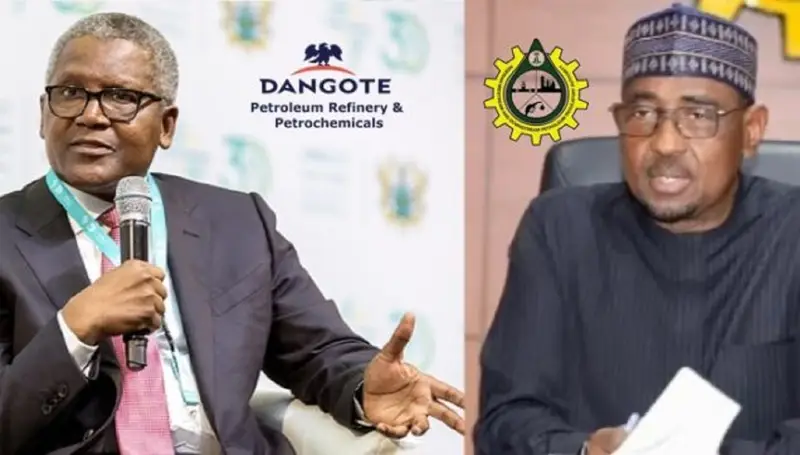
Nigeria’s downstream petroleum sector has been thrown into fresh turbulence as the long-simmering dispute between Dangote Refinery President Aliko Dangote and the Chief Executive Officer of the Nigerian Midstream and Downstream Petroleum Regulatory Authority (NMDPRA), Farouk Ahmed, reignites this time with visible consequences at fuel pumps across the country.
The renewed clash, which has also drawn in fuel importers and marketers, coincides with a sharp reduction in petrol prices, pushing retail rates to their lowest levels in months nationwide.
On Sunday, Dangote escalated the confrontation, accusing the NMDPRA boss of undermining Nigeria’s economy by encouraging fuel imports despite the operational capacity of his refinery. He further alleged that Ahmed paid as much as $5 million estimated at over ₦7 billion as school fees for his children in Switzerland, an allegation the regulator had earlier dismissed as false.
ALSO: Dangote Slams NMDPRA CEO Farouk Ahmed Over Alleged $5m School Fees in Switzerland
The tuition claim was first aired by a coalition of civil society organisations operating under the banner of Lawyers in Defence of Good Governance. While Dangote repeated the accusation during his Sunday briefing, the same CSO walked back its claims a day later.
In a statement issued on Monday, the group’s director, Olawale Mudasiru, admitted that the allegation was based on misinformation. According to him, Ahmed’s children were beneficiaries of scholarships and had completed their education before his appointment as NMDPRA chief.
Despite the retraction, the damage had already been done, with the claims fuelling anxiety and speculation across the downstream petroleum value chain.
Price cuts as strategy
Dangote’s latest outburst came against the backdrop of a dramatic reduction in gantry prices by the Dangote Refinery from ₦828 to ₦699 per litre a move widely seen as a direct challenge to fuel importers. As of last week, importers’ ex-depot prices hovered around ₦824 per litre, leaving them struggling to compete.
Addressing the media, Dangote declared that Nigerians should not pay more than ₦740 per litre for petrol in December and January, beginning from Tuesday. He also vowed to deploy his financial strength to force fuel prices down.
Industry stakeholders, however, view the move less as philanthropy and more as a calculated market strategy aimed at squeezing out importers and compelling marketers to rely almost exclusively on Dangote’s locally refined petrol.
Pump prices respond
Across Abuja, early signs of a price war have begun to emerge. Checks showed that Bovas Filling Station in Wuse Zone 6 reduced its pump price to ₦865 per litre from ₦910 earlier in the day.
Other stations, including Empire Energy and Ranoil outlets in Gwarimpa, adjusted prices to ₦912 and ₦910 per litre respectively. Nigerian National Petroleum Company Limited (NNPC) partner stations, alongside AA Rano outlets, were selling between ₦905 and ₦915 per litre as of Monday night.
A manager at an MRS filling station, who spoke anonymously, confirmed that while petrol was still selling at ₦910 per litre, a downward adjustment was expected from Tuesday.
At the depot level, private operators such as Menj, Bovas, AA Rano and Integrated reportedly slashed prices to around ₦710 per litre, down from about ₦824. Meanwhile, ex-depot prices at AYM Shafa, Ranoil and similar facilities stood at roughly ₦815 per litre.
Marketers confirm nationwide rollout
The Independent Petroleum Marketers Association of Nigeria (IPMAN) has confirmed that the price reduction will soon reflect nationwide.
Speaking exclusively, IPMAN spokesperson Chinedu Ukadike said Nigerians would begin to feel the full impact of the price cuts from Tuesday through the following week.
“From Tuesday and into next week, Nigerians will start seeing the reactions and the dividends of this reduction in petroleum price,” he said.
Ukadike also urged restraint in the ongoing feud, calling for cooperation between Dangote Refinery and the NMDPRA in the interest of consumers.
“They need to collaborate to ensure steady supply and allow Nigerians truly benefit from the reduced price,” he appealed.
Despite the price movement, transport fares in Abuja and other major cities remained unchanged as of Monday, suggesting that the relief is yet to trickle down to commuters.
Warnings from retailers
Not everyone is convinced the price cuts will endure. The National President of the Petroleum Products Retail Outlets Owners Association of Nigeria (PETROAN), Billy Gillis-Harry, warned that the Dangote–Ahmed feud may not ultimately benefit Nigerians.
In an interview, he dismissed claims that there was a deliberate attempt to frustrate the Dangote Refinery, describing such narratives as “phantom talks” driven by rivalry and a struggle for market dominance.
According to him, it would be irrational for anyone to sabotage a major national asset.
“These are phantom talks playing around in the industry for dominance, for an oligarch to take over the industry,” he said.
Gillis-Harry noted that existing arrangements already prioritise petrol from the Dangote Refinery over imports, stressing that marketers are not opposed to local refining. However, he cautioned against what he described as unsustainable pricing tactics.
“If he wakes up and starts reducing prices, maybe he has a lot of money he wants to burn. At the end of the day, we will see how it plays out for Nigeria,” he said.
He warned that artificially low prices could destabilise the market and harm the economy over time.
“You may enjoy incorrect pricing for one week or one month, but what happens afterwards? Nigerians will suffer when the push comes to shove,” he added.
Gillis-Harry urged industry players to avoid short-term populist tactics, insisting that only fair and accurate pricing would serve Nigerians in the long run.
Regulatory tensions persist
Meanwhile, the House of Representatives Committee on Petroleum Resources (Downstream) has intervened, urging both Dangote and the NMDPRA to de-escalate tensions.
Recent NMDPRA data showed that of the 52.9 million litres of petrol consumed daily in Nigeria, only 19.5 million litres are supplied by the Dangote Refinery, with imports still dominating supply. This reality, the data suggested, informed the federal government’s decision to suspend a proposed 15 per cent import duty on refined petroleum products.
Dangote has since questioned the accuracy of the regulator’s figures, further deepening the rift.
The latest episode revives memories of the 2024 war of words between Dangote and Ahmed over allegations that petrol produced by the $20 billion refinery contained high sulphur levels claims that were also strongly contested.
As prices fall and tempers rise, Nigerians are left watching closely, uncertain whether the current relief at the pump marks a lasting shift or merely another short-lived episode in the country’s volatile fuel market.