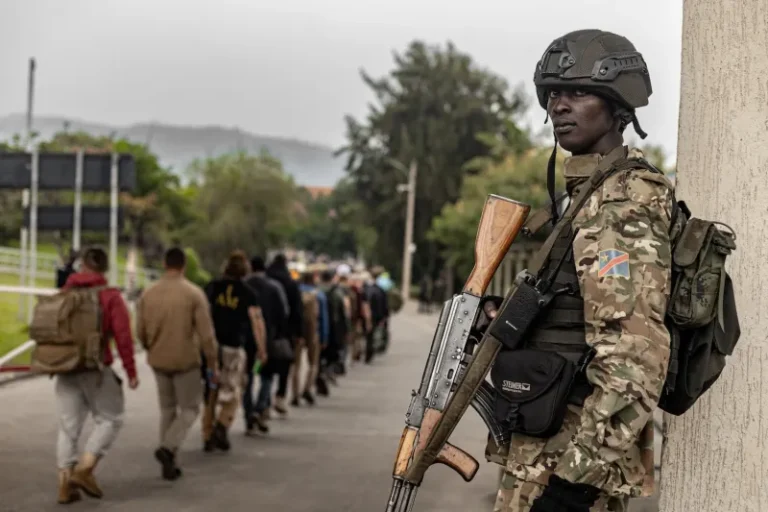
In a major diplomatic breakthrough, NewsOnline Nigeria reports that the Democratic Republic of the Congo (DRC) and Rwanda have signed a landmark peace agreement aimed at ending one of Africa’s longest-running and deadliest conflicts. The accord, brokered by the United States in collaboration with Qatar, was signed on Thursday at the U.S. State Department in Washington, D.C.
The deal, hailed as a “turning point” in regional stability efforts, commits both nations to halting military incursions and ending support for proxy armed groups. It also lays out ambitious political, economic, and humanitarian milestones designed to reverse decades of violence and exploitation in the mineral-rich eastern provinces of the DRC.
Tensions between the two neighbours have persisted since the 1994 Rwandan genocide, when Hutu extremists fled into eastern Congo, forming the Democratic Forces for the Liberation of Rwanda (FDLR). Rwanda has repeatedly used the FDLR’s presence to justify cross-border operations. Meanwhile, Kinshasa and international observers—including the United Nations—have accused Rwanda of backing the Tutsi-led M23 rebel group, which earlier this year seized key cities like Goma and Bukavu in the DRC, establishing parallel governance and security structures.
While Kigali denies any support for M23, U.N. reports have provided evidence of Rwandan troops and weapons aiding the insurgency.
The accord outlines clear obligations for both parties:
Crucially, the agreement links peace to economic development. Within 90 days, both nations will launch a Regional Economic Integration Framework focused on:
U.S. officials have been blunt about American interests. “We’re getting a lot of the mineral rights from the Congo,” former President Donald Trump said. Secretary of State Marco Rubio offered a more measured tone, calling the effort one of “hope and prosperity” for the region.
The deal also ties into a broader U.S. strategic push, including a $3 billion investment in the Lobito Corridor project—linking mineral hubs in Zambia, DRC, and Angola to global markets via the Atlantic.
Despite its ambition, the agreement faces considerable hurdles. The M23 rebel group—controlling large swaths of North and South Kivu—was not a signatory to the deal, and their stance remains uncertain. Rwanda claims M23 is independent and cannot be forced to disband; Kinshasa counters that peace is meaningless if the group remains active.
Analysts also warn of deeper systemic issues. “If not managed properly, new mineral deals could reinforce the very drivers of conflict,” notes the Atlantic Council, citing corruption, child labour, and weak local governance. Koen Vlassenroot of the University of Ghent argues that identity politics, exclusion, and political patronage remain key sources of instability in the region.
Geopolitical rivals such as China and Russia—both of whom have longstanding interests in the region—are closely monitoring developments. The U.S. is hoping that security guarantees and economic incentives will tilt the balance of power toward long-term peace and Western-aligned development.
Speaking after the signing, DRC Foreign Minister Thérèse Kayikwamba Wagner said, “This moment has been long in coming. It will not erase the pain, but it can begin to restore what conflict has robbed many women, men and children of—safety, dignity, and a sense of future.”
Whether this peace deal marks a genuine turning point or becomes another missed opportunity in Central Africa will depend on implementation, inclusive dialogue, and how mineral wealth is managed going forward.
Credit: Christopher Burke, Senior Advisor, WMC Africa.
Supreme court has voided PDP Ibadan convention and nullified Turaki-led factional executives. NewsOnline Nigeria…
Let’s stop pretending: what Nigeria practices today hardly reflects the true essence of democracy. Instead,…
David Mark has stated that ADC will be on the 2027 elections ballot despite court…
NNPCL has raised fuel pump price to N1,364 per litre after Dangote Refinery increase. …
IGP Disu has ordered the dismissal and prosecution of ASP Nuhu Usman over alleged extrajudicial…
FG has declared Friday, May 1st Public Holiday for 2026 Workers’ Day. NewsOnline Nigeria…