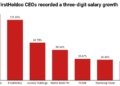
First HoldCo Plc, the parent company of FirstBank Nigeria, recorded a sharp 79.4 per cent decline in profit for the 2025 financial year, even as remuneration for its highest-paid director more than doubled, according to the group’s audited financial statements.
The company’s profit for the year fell to ₦139.5 billion, from ₦677 billion recorded in the previous year, representing a decline of about 79.4 per cent.
Against that backdrop, remuneration paid to the group’s highest-paid director increased from ₦97 million in 2024 to ₦195 million in 2025, representing a 101 per cent increase.
The contrasting figures place executive compensation under fresh scrutiny, particularly as shareholders contend with a steep deterioration in reported earnings.
ALSO: Zoho Launches Nigeria Edition of Zoho Books to Boost VAT, E-Invoicing Compliance
The decline in profitability was accompanied by significant increases in some major cost items. First HoldCo’s impairment charges rose to ₦826.3 billion, an increase of about 93.8 per cent from the previous year, while operating expenses climbed 32.1 per cent to ₦1.23 trillion.
The group’s profit before tax also plunged by approximately 70.5 per cent to ₦235 billion, despite gross earnings rising 6.9 per cent to ₦3.44 trillion.
Net interest income provided some positive movement, increasing by 36.8 per cent to ₦1.92 trillion, but the improvement was not enough to offset the impact of impairments and other expenses on the bottom line.
The disparity between earnings and executive remuneration is particularly striking at the individual director level.
While the highest-paid director’s remuneration doubled to ₦195 million, total directors’ emoluments increased more moderately from ₦936 million to ₦992 million.
Executive compensation, however, rose substantially, increasing from ₦159 million in 2024 to ₦294 million in 2025. Key management compensation also increased from ₦4.76 billion to ₦8.92 billion, while salaries and short-term employee benefits climbed from ₦4.46 billion to ₦8.41 billion.
The figures also coincided with weaker profitability indicators. First HoldCo’s post-tax return on average equity fell to 4.6 per cent, from 29.8 per cent, while return on average assets dropped to 0.5 per cent, compared with 3.1 per cent previously.
The group’s non-performing loan ratio also increased from 10.2 per cent to 12 per cent, pointing to additional pressure within the loan portfolio.
The 2025 results therefore present a sharp contrast: revenue-related indicators recorded growth, but substantially higher impairment charges and operating costs contributed to a major deterioration in bottom-line earnings.
For shareholders, the remuneration figures raise questions about how executive compensation is structured against financial performance, risk management and returns to investors.
The 101 per cent increase in the highest-paid director’s remuneration does not, by itself, establish that the pay was inappropriate. Executive remuneration can include contractual compensation, incentives and payments linked to responsibilities or performance measures that extend beyond a single year.
However, the scale of the increase against a nearly 80 per cent fall in annual profit creates a clear governance issue for shareholders to examine, particularly regarding the relationship between executive rewards and the financial outcomes recorded during the year.
First HoldCo’s 2025 numbers consequently highlight a difficult year for the group: earnings collapsed, impairment costs surged and profitability ratios weakened, while senior management compensation moved in the opposite direction.
The company’s financial statements provide the figures; the question for investors and other stakeholders is how the board’s remuneration framework accounts for such divergent outcomes.