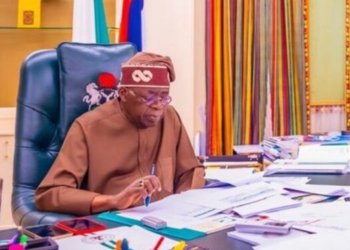
FG has budgeted N135.22bn for 2027 post-election legal battles.
NewsOnline Nigeria reports that the Federal Government of Nigeria has proposed N135.22 billion in the 2026 budget for what it described as “Electoral Adjudication and Post-Election Provision,” signalling a major financial commitment to managing legal disputes and obligations that typically follow elections in the country.
The provision was contained in the House of Representatives Order Paper for March 31, 2026, which includes the report on the 2026 Appropriation Bill. The allocation was listed under Service-Wide Votes, a centrally managed pool of funds used by the government to finance obligations not tied to a specific ministry, department, or agency.
ALSO: Remita Faces Regulatory Heat as NDPC Launches Investigation Over Alleged Data Breach
Service-Wide Votes are often regarded as contingency funds within the federal budget and are used to cover expenses that cut across multiple institutions, including unforeseen national obligations and liabilities that cannot easily be assigned to a single agency.
Within this framework, the N135.22bn provision indicates that the government anticipates continued fiscal pressure arising from election-related legal disputes, settlements, and administrative processes.
Further analysis of the appropriation document shows the provision is part of the broader Consolidated Revenue Fund charges, which stood at about N3.70 trillion in the 2026 proposal. The electoral adjudication allocation alone accounts for roughly 3.65 per cent of that segment of spending.
The budget proposal also includes a much larger N1.01 trillion statutory transfer to the Independent National Electoral Commission (INEC), making it the largest recipient within the statutory transfer category, which totals N4.80 trillion.
Statutory transfers are constitutionally backed allocations paid directly from the Consolidated Revenue Fund to institutions such as INEC, the National Assembly of Nigeria, and the National Judicial Council. These funds are released as a first-line charge and are not subject to direct executive control, giving recipient agencies a degree of financial autonomy.
Earlier in February, INEC informed the National Assembly that it would require N873.78bn to conduct the 2027 general elections, alongside N171bn for its operational activities in the 2026 fiscal year. The proposed election budget represents a significant increase from the N313.4bn spent on the 2023 general elections.
Opposition parties raise concerns
Opposition parties, including the Peoples Democratic Party (PDP) and the African Democratic Congress (ADC), have questioned the transparency and rationale behind the N135.22bn provision for post-election legal matters.
PDP National Publicity Secretary Ini Ememobong argued that the allocation suggests an expectation of widespread disputes following the 2027 polls, which he said raises concerns about the credibility of the electoral process.
Similarly, ADC spokesperson Bolaji Abdullahi acknowledged that the electoral commission is often involved in post-election litigation but described the scale of the proposed allocation as excessive.
Experts and civil society react
Political economist Pat Utomi questioned why the federal government should budget for election-related litigation, arguing that elections are contested by candidates rather than the government itself.
Human rights lawyer Femi Falana (SAN) also criticised the amount as unjustifiably high, noting that INEC already has a legal department and typically pays limited fees even to senior advocates handling election cases. According to him, the electoral commission may not spend up to N20bn on election litigation in reality.
Civil society organisations also expressed concern over the allocation. The Executive Director of FixPolitics Africa, Anthony Ubani, warned that budgeting heavily for election disputes could weaken public confidence in Nigeria’s democracy by shifting the focus from credible elections to courtroom battles.
Similarly, the Executive Director of the Civil Society Legislative Advocacy Centre, Auwal Rafsanjani, said credible and transparent elections would significantly reduce the need for costly post-election litigation.
The controversy highlights broader concerns about the rising cost of elections and the growing reliance on courts to determine electoral outcomes in Nigeria.