In his book, Politics, the great philosopher, Aristotle said that ” every state is a community of some kind, and every community is established with a view to some good for mankind, always act in order to obtain that which they think is good. But if this is so, then the state or political community, which is the highest of all, and which embraces all the rest, aims at Good in greater degree than any other, and at the highest good.”
Aristotle further stated that some people think that the qualifications of a statesman, king, householder and master are the same, and that they are different , not in kind, but only in the number of their subjects. For example, the ruler of a few is called a master, over more, a manager and over a still larger number, a statesman or a king, as if there were no difference between a great household and a small state. The distinction between the King and the Statesman, Aristotle concluded is that when government is personal, the ruler is a King; when according to the rule of political science, the citizen’s rule and are ruled in turn, then he is called a Statesman.”
This Aristotelian postulation, connotes that statesmen can only thrive in a democracy. History however, replete with statesmen who thrived in our world. In some few cases, some military and autocratic leaders managed to be regarded as statesmen. For instance, Fidel Castro of Cuba, Chairman Mao of China etc.
But if we look inward, in Nigeria, it is very difficult to call or regard any of our political gladiators or leaders as statesmen. Unfortunately, it is like a curse has been placed on us because what we have are corrupt, despotic, self-serving, selfish and evil rulers. Many of our past rulers have the opportunity to write their names in gold and be called statesmen but they flunked it because of their inordinate ambition, long throat and appetite for corruption. And this has cast a shadow on the character of our political and military leaders who have had the opportunity to rule Nigeria.
Today our leaders are culpable as problems to the growth of our democracy and political developments. However, the major problems according to political analysts are the political parties, political actors and our penchant for corruption and the dishonesty of our people.
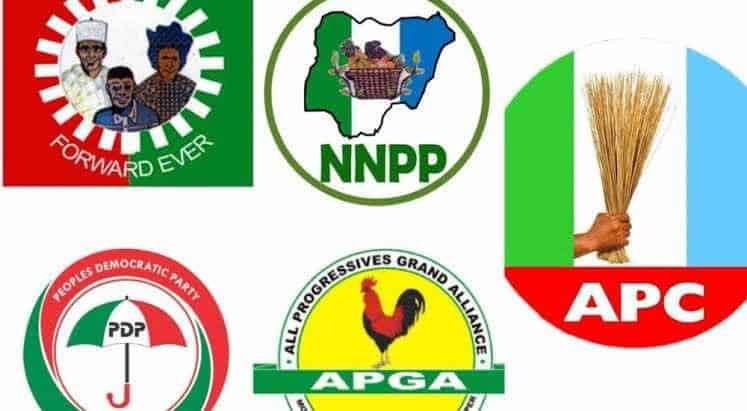
Take a look at our political parties-PDP, APC, APGA, NNPP, ADC, LABOUR etc. and the rate of defections from one party to the other under the pretext that they want to align with the political party in power, some alluded their cross-carpeting to disenchantment in the parties and promises of financial gains or promises of positions. This reveals the real intentions of our politicians and the political parties we have in Nigeria. The show of shame and infighting among the political leaders in order to control party structures is appalling and alarming. It also shows lack of vision, commitments and paucity of ideas.
The state of our political parties today is that all the parties are terribly in a bad shape and structures. In his opinion in ThisDay of 18 February 2018, Remi Ogunmefun opined that ” nearly all the major political parties in Nigeria are in a bad shape if juxtaposed to what is expected of a political party in a true and growing democracy. He noted that these political parties are not political parties in their true definition, and cannot enable us to sustain good public governance and rightly so. This he stated is because there is a mismatch between the quality of party membership and policy evolution saying ” the quality of people who constitute the large majority of membership of our political parties have little or no education and many unsuited to articulate policies for effective government”.
However, the way out of this political quagmire is that our political parties need to reform and improve on quality of membership and the right people must targeted and recruited into the parties. This is perhaps the only way to reposition our political parties for a result-oriented outcomes in the near future.