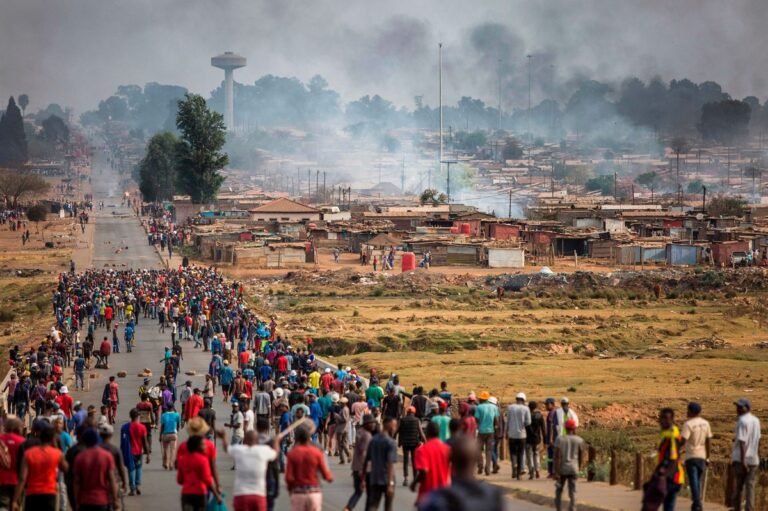
For more than two decades, South Africa has experienced repeated outbreaks of violence aimed mainly at immigrants from neighbouring countries and other parts of Africa. Critics have argued that political violence around immigration and deep economic frustrations fuelled the hostility towards foreign nationals, leading to many being beaten, killed, displaced, and their businesses looted. After the end of the apartheid regime in 1994, South Africa became a major attraction for immigrants from other African countries, seeking to work there. Many arrived from neighbouring countries that faced economic recession, conflicts, and political repression at a time when South Africa is struggling with employment, inequality, and increasingly poor services.
In 2019, when violence swept through parts of Johannesburg and Pretoria, at least 12 people were killed, and hundreds of businesses were looted or destroyed. Nigeria evacuated more than 500 of its citizens from South Africa as these attacks triggered a diplomatic crisis. Tensions around immigration have remained high, particularly against the backdrop of South Africa’s escalating economic crisis.
A fresh outbreak of violence in 2026 triggered protests from leaders in Nigeria, Ghana, and neighbouring African countries, with renewed criticisms of South Africa’s handling of Xenophobia. According to Nigeria’s Foreign Minister, Bianca Odumegwu-Ojukwu, “Nigerian lives and businesses in South Africa must not continue to be put at risk.” Nigeria also raised the issue and offered to repatriate its citizens back home amid fears of attacks. Moreover, in the face of these xenophobic tantrums, Ghana’s government wrote to the African Union. In the letter, Ghana said that what it called xenophobia in South Africa “presents a challenge to the shared principles of African solidarity, brotherhood and continental unity,” asking the continental body to discuss the issue, which it says is a serious risk to the safety and well-being of African in South Africa. Similarly, Kenya, Malawi, Lesotho, and Zimbabwe have also warned their citizens in South Africa to be on the lookout for possible attacks.
It is unfortunate that blacks and African immigrants, who make up more than two-thirds of South Africa’s estimated 3 million foreign immigrants, are frequently targeted as scapegoats for their structural problems. Many observers have warned that South Africa’s problem with xenophobic violence has become a recurring decimal, always surfacing whenever economic or political pressures arise. This reveals how hardship can quickly be turned to hostility. No doubt that the xenophobic violence in South Africa reveals a complex interplay between socio-economic deprivation, group conflicts, and violence. In the midst of this violence, the official South African government response to Xenophobia and related problems has been characterised by a lack of political will, denials, and impunity of the actors involved.
However, what is required in the face of this xenophobic violence is that only a sustained state political will, informed by accountability, rule of law, and eradication of impunity can help prevent xenophobic violence or at least mitigate its effects. But if the South African government failed, it could hinder the principles of African solidarity, brotherhood, and continental unity.
Drug abuse among undergraduate students has become one of the most alarming social challenges confronting…
In Nigeria’s evolving democratic space, leadership is increasingly being reduced to a struggle for personal…
JAMB has exempted Education and Agriculture Candidates from UTME Requirement. NewsOnline Nigeria reports that…
President Tinubu has given crucial appointment to Retired Major General Adeyinka Fadewa. NewsOnline Nigeria…
JAMB 2026 University Admission Cut-Off Mark has been released by the examination umpire. NewsOnline…
Nigeria’s economic resilience has historically been driven by its nano and micro-enterprises, ranging from roadside…