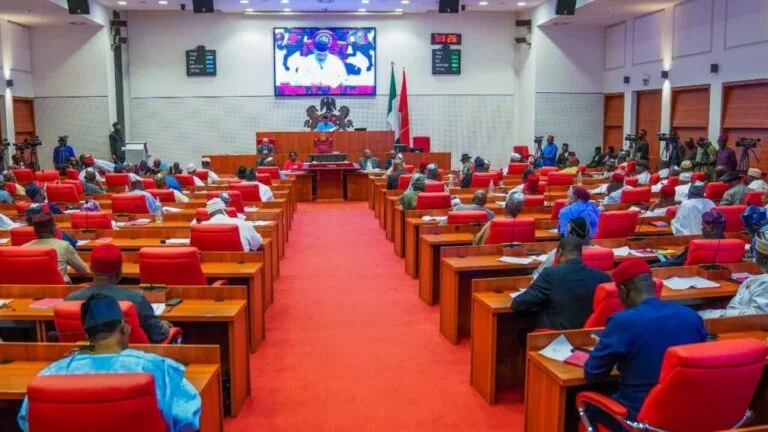
NewsOnline Nigeria reports that barely a year to the inauguration of the 11th National Assembly, the Nigerian Senate has amended its Standing Rules, introducing stricter eligibility criteria that effectively limit access to key leadership positions and sideline a category of incoming lawmakers, including outgoing governors and returning political heavyweights.
Following a closed-door session lasting about three hours, the red chamber revised Orders 4 and 5, reinforcing a hierarchy that prioritises ranking senators with legislative experience for presiding and principal offices.
Under the amended Order 4, nominations for presiding officers such as Senate President and Deputy Senate President will strictly follow a defined ranking structure. Priority is given to former Senate Presidents, former Deputy Senate Presidents, former principal officers, and senators with at least one full term. Former members of the House of Representatives are next in line, while first-time senators are only considered as a last resort.
More significantly, the revised Order 5 introduces a tougher condition, stating that only senators who have served at least two consecutive terms immediately before nomination can contest for principal offices. This effectively disqualifies many incoming lawmakers who were not part of both the 9th and 10th National Assemblies.
The changes are widely seen as a pre-emptive move amid rising interest from outgoing governors and influential politicians preparing to enter the Senate in 2027, many with ambitions to occupy top leadership roles.
With at least 10 governors expected to complete their constitutionally permitted two terms by May 29, 2027, the race for senatorial seats has intensified. Several of them are already positioning to secure party tickets, leveraging their control of state political structures.
Among those nearing the end of their tenure are AbdulRahman AbdulRazaq (Kwara), Abdullahi Sule (Nasarawa), Ahmadu Fintiri (Adamawa), Babagana Zulum (Borno), Inuwa Yahaya (Gombe), Mai Mala Buni (Yobe), Babajide Sanwo-Olu (Lagos), Dapo Abiodun (Ogun), Seyi Makinde (Oyo), and Bala Mohammed (Bauchi).
In Imo State, political activities have heightened as Governor Hope Uzodimma is being positioned for the Imo West senatorial seat, with party leaders reportedly backing him as a consensus candidate. However, the race is complicated by the interest of former Governor Rochas Okorocha, who is also seeking a return to the Senate.
The broader political environment has been shaped by President Bola Tinubu’s reported stance against automatic tickets for lawmakers, reaffirming the influence of governors over party nominations ahead of the elections.
Against this backdrop, the Senate’s rule amendments appear aimed at preserving institutional continuity and ensuring that leadership positions remain within the grasp of experienced lawmakers, rather than newcomers with significant political influence but limited legislative background.
As preparations for the 2027 general elections gather momentum, the new rules send a clear signal that seniority and experience within the Senate will play a decisive role in determining its leadership in the next assembly.
FG has been urged to revoke MTN Group and MultiChoice licences over Xenophobic attacks on…
Peter Obi and Rabiu Kwankwaso exit have triggered mass defections and weakened ADC in National…
ICPC has opposed El-Rufai’s fresh bail application as court adjourns hearing to May 13. …
INEC has announced final phase of Continuous Voter Registration and set May 11–July 10 timeline.…
Zenith Bank Founder Jim Ovia has retired and Engr. Mustafa Bello appointed new Group Chairman.…
Ben Ayade has cried foul over alleged Bola Tinubu directive to quit senate race. …