Even throughout their rule of Afghanistan from 1996 to 2001, the Taliban movement’s inner workings and leadership were cloaked in mystery.
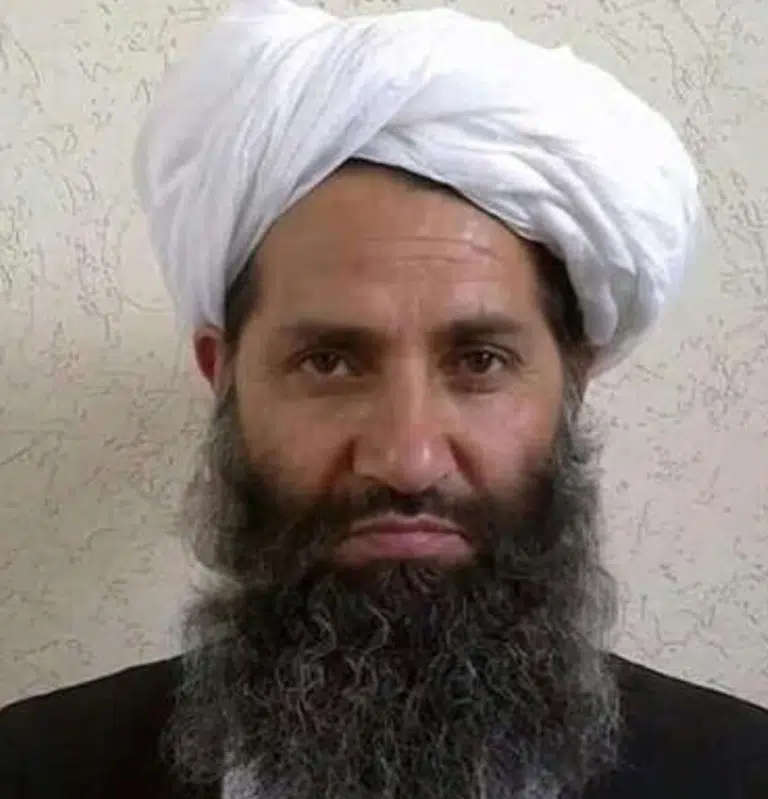
The supreme leader, Haibatullah Akhundzada
After his predecessor, Mullah Mansour Akhtar, was murdered in a US drone strike in 2016, Haibatullah Akhundzada was proclaimed Taliban commander in a hasty power transition.
Akhundzada was a low-profile religious figure before joining the movement’s ranks. He is commonly assumed to have been chosen as a spiritual leader rather than a military commander.
Following his appointment as leader, Akhundzada received a promise of allegiance from Al Qaeda’s Ayman al-Zawahiri, who praised the religious scholar and referred to him as “the emir of the faithful.”
On July 18, 2021, Mullah Abdul Ghani Baradar, the leader of the Taliban negotiating team, looks on as the final declaration of the peace talks between the Afghan government and the Taliban is presented in Doha, Qatar’s capital.
Mullah Abdul Ghani Baradar, a member of the Taliban negotiation team, watches as the final declaration of the peace talks between the Afghan government and the Taliban is presented in Doha, Qatar, on July 18, 2021.
This helped solidify his jihadist credentials among the group’s long-time allies.
Following the assassination of his predecessor and the revelation that the leadership had covered the death of Taliban founder Mullah Omar for years, Akhundzada was tasked with the difficult job of reconciling a militant force that had briefly fragmented during a brutal power struggle.
The leader’s public profile has primarily been limited to annual messages delivered during Islamic festivals.
Abdul Ghani Baradar was born and raised in Kandahar, the Taliban’s birthplace.
Baradar’s life, like that of other Afghans, was forever changed by the Soviet invasion of the nation in the late 1970s, which turned him into an insurgent.
He was said to have battled alongside Mullah Omar, the one-eyed preacher.
In the early 1990s, amid the turmoil and corruption of the civil war that ensued after the Soviet withdrawal, the two would create the Taliban movement.
Following the Taliban’s defeat in 2001, Baradar is thought to have been one of a small group of insurgents who approached interim Afghan President Hamid Karzai with a letter proposing a possible arrangement in which the militants would recognize the new government.
Baradar was arrested in Pakistan in 2010 and held in captivity until he was released and transported to Qatar in 2018 as a result of US pressure.
He was appointed chief of the Taliban’s political office here, where he oversaw the signing of the US pullout deal.
The Haqqani Network, Sirajuddin Haqqani
Jalaluddin Haqqani’s son is a well-known anti-Soviet jihad commander.
Sirajuddin serves as the Taliban’s deputy leader as well as the head of the strong Haqqani network.
The Haqqani Network is a terrorist organization identified by the United States that has long been regarded as one of the most deadly factions battling Afghan and US-led NATO forces in Afghanistan during the past two decades.
The group is known for using suicide bombers and is suspected of being behind some of Kabul’s most high-profile strikes in recent years.
The network is also accused of assassinating prominent Afghan officials and kidnapping and detaining for ransom Western individuals, including US soldier Bowe Bergdahl, who was liberated in 2014.
The Haqqanis are thought to oversee operations in the rocky mountains of eastern Afghanistan, while also wielding great power over the Taliban’s leadership council. They are known for their independence, military prowess, and astute financial transactions.
The scion of Mullah Yaqoob
Mullah Omar, the Taliban’s founder’s son.
Mullah Yaqoob is the chairman of the insurgency’s strong military commission, which is in charge of overseeing a broad network of field commanders tasked with carrying out the insurgency’s strategic activities in the conflict.
His ties to his father, the Taliban’s commander, who had cult-like status, serve as a powerful symbol and help him unite a dispersed movement.
However, there is still a lot of uncertainty about Yaqoob’s real role in the movement, with some experts claiming that his appointment in 2020 was purely cosmetic.
EFCC has come under fire over hospital evasion and doctor brutality in Uyo. NewsOnline…
Embattled APC Rivers Governor, Sim Fubara has broken silence on his alleged defection to NDC.…
EFCC has arrested Energy Commission DG Mustapha Abdullahi over alleged N500bn money laundering. NewsOnline…
Lagos Assembly Speaker Obasa has declared for Agege Reps seat. NewsOnline Nigeria reports that…
President Tinubu has demanded global financial reforms and claimed that Africa’s growth is being stifled.…
NDC has fixed presidential nomination form at N60m and released primary election timetable. NewsOnline…