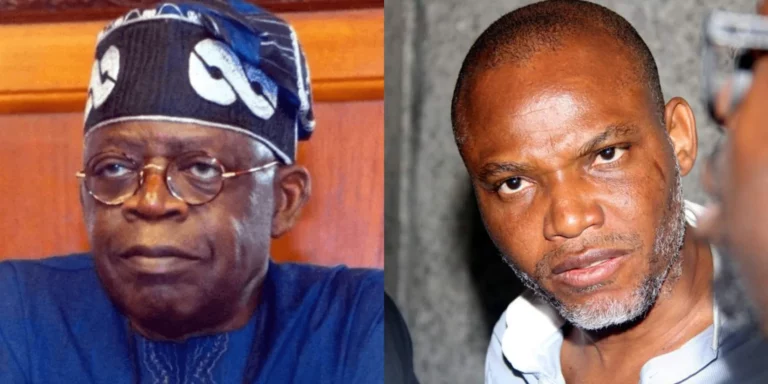
During his Democracy Day address at a joint sitting of the National Assembly, President Bola Ahmed Tinubu announced the posthumous pardon of the Ogoni Nine, including iconic environmental activist Ken Saro-Wiwa, in a symbolic act of national reconciliation. However, in a move that has drawn sharp contrasts, the President remained silent on the growing appeals to grant clemency to detained IPOB leader Nnamdi Kanu.
The Ogoni Nine were executed in 1995 by the military regime of General Sani Abacha for protesting environmental degradation in the Niger Delta. President Tinubu’s pardon, seen as a symbolic attempt to heal historic injustices, was widely welcomed by rights groups and international observers.
“Today, we close a dark chapter. We honour those who died not as criminals but as patriots,” Tinubu declared during the address.
Yet, for many observers and southeastern leaders, this gesture rings hollow without corresponding action in the present, particularly concerning the case of Nnamdi Kanu, whose continued detention has become a flashpoint in Nigeria’s national discourse.
Despite months of lobbying by southeastern lawmakers, traditional rulers, and civil society advocates, Tinubu made no mention of Kanu’s case during the speech. Earlier in the year, Hon. Kama Nkemkanma and the Ohanaeze Ndigbo Worldwide had formally urged the President to “temper justice with mercy” and release Kanu under the Renewed Hope Agenda.
Proponents argue that pardoning Kanu would help restore peace and economic normalcy in the South-East, which continues to suffer from insecurity and crippling sit-at-home orders linked to his detention. Some estimates suggest that the region has lost over ₦7.6 trillion in two years due to instability tied to the issue.
“If we can forgive the past to build unity, we must also confront the present to preserve the future,” a southeastern senator noted after the address.
The juxtaposition of posthumous pardons and present-day silence has drawn criticism from rights advocates and political analysts. While the gesture toward the Ogoni Nine is hailed as long overdue, many believe reconciliation must also address current political detainees like Kanu to be meaningful.
“You can’t celebrate democracy while holding political prisoners,” said a spokesperson for a Southeast civil society coalition.
Critics argue that while symbolic justice is important, true democracy demands fairness in ongoing legal and political matters. They call for a consistent approach to reconciliation that includes both historical redress and contemporary justice reform.
As the Tinubu administration moves forward, pressure is mounting for a more comprehensive national healing strategy; one that extends beyond symbolism to address real-time political grievances. Whether Nnamdi Kanu’s continued detention will evolve into the kind of turning point Saro-Wiwa’s legacy has become remains uncertain.
But for many, June 12 has now become both a celebration of the past and a reminder of the unfinished business of Nigeria’s democratic journey.
Boko Haram Terrorists has attacked Chibok Community and set houses ablaze. NewsOnline Nigeria reports…
NASU and SSANU has commenced nationwide strike over unresolved allowance dispute. NewsOnline Nigeria reports…
President Tinubu has appointed Rilwan Babalola as Special Adviser on Power and set up Presidential…
Supreme court has restored David Mark as ADC National Chairman and voided appeal court order.…
Supreme court has voided PDP Ibadan convention and nullified Turaki-led factional executives. NewsOnline Nigeria…
Let’s stop pretending: what Nigeria practices today hardly reflects the true essence of democracy. Instead,…