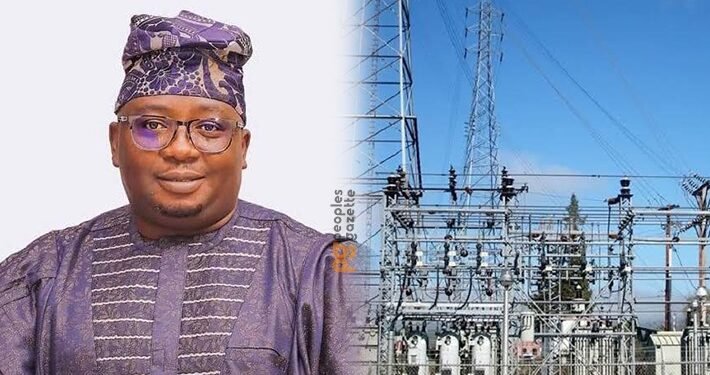
President Tinubu has come under pressure to sack Power Minister Adebayo Adelabu over persistent blackouts.
NewsOnline Nigeria reports that persistent electricity blackouts across several Nigerian states have intensified public calls for the removal of Adebayo Adelabu as Minister of Power by President Bola Ahmed Tinubu.
Over the past four months, electricity supply has remained highly unstable, with power generation fluctuating between 2,000 and 4,000 megawatts, far below the demand of Nigeria’s population of more than 250 million people. As of March 29, 2026, electricity distribution companies received only 2,855 megawatts, highlighting the severity of the supply deficit.
Electricity distribution companies (Discos) have attributed the erratic supply to reduced power generation, while generation companies (Gencos) say the situation is largely due to gas supply constraints tied to mounting debts reportedly exceeding ₦4 trillion.
ALSO: NNPC Cuts Petrol Price to N1,295/Litre After Dangote Refinery Slashes Gantry Rate
The ongoing crisis has left households and businesses across Nigeria grappling with unreliable electricity supply.
Amid growing public frustration, Adelabu recently issued an apology to Nigerians, acknowledging the deep challenges confronting the power sector.
Meanwhile, President Tinubu, speaking at the All Progressives Congress convention, said the proposed Grid Asset Management Company (GAMCO) could help address financial and structural issues in the sector.
“Many of you are lamenting the problem of electricity; we are paying attention to it. The GAMCO will inject 150,000 MW into the electricity corridors,” Tinubu said.
Calls for Adelabu’s resignation intensify
In reaction to the ongoing crisis, Eze Onyekpere, lead director of the Centre for Social Justice, called for Adelabu’s immediate removal, describing the minister’s performance as disappointing.
Speaking in an interview, Onyekpere criticized the minister for what he described as a lack of direction and innovation in addressing the country’s electricity challenges.
He also reminded President Tinubu of his campaign promise to improve electricity supply, stressing that current realities in the power sector fall far short of expectations.
According to him, leadership in such a critical sector requires clear vision and decisive action.
“He should either resign or get sacked. He has no ideas or innovation,” Onyekpere said.
Governance failure, not ministerial incompetence — Expert
However, Wumi Iledare, Professor Emeritus of Petroleum Economics, argued that the root of the crisis lies in systemic governance failures rather than the competence of the power minister.
Iledare maintained that blaming Adelabu alone would not solve the deeper structural challenges facing the sector.
“The problem of the power sector in Nigeria, in my opinion, is governance, not the competence of the minister of power,” he said.
According to him, the federal government must revisit the original framework used during the privatization of the power sector, which he believes contributed to the current challenges.
He warned that poor policy implementation could eventually spill over into the oil and gas industry if urgent reforms are not carried out.
Experts propose decentralised power market
On possible solutions, Iledare advocated for the decentralization of the electricity market into regional systems, where states collaborate to generate and distribute electricity more effectively.
He also called for stronger institutional frameworks and better coordination within the Ministry of Power, stressing that lasting reforms depend more on institutional strength than individual leadership changes.
“What we had in mind when we were calling for decentralization is a regional market — a coming together of states, not necessarily standing alone,” he explained.
The ongoing debate underscores the urgency of reforms in Nigeria’s struggling electricity sector, as citizens and businesses continue to face the economic and social consequences of persistent power outages.