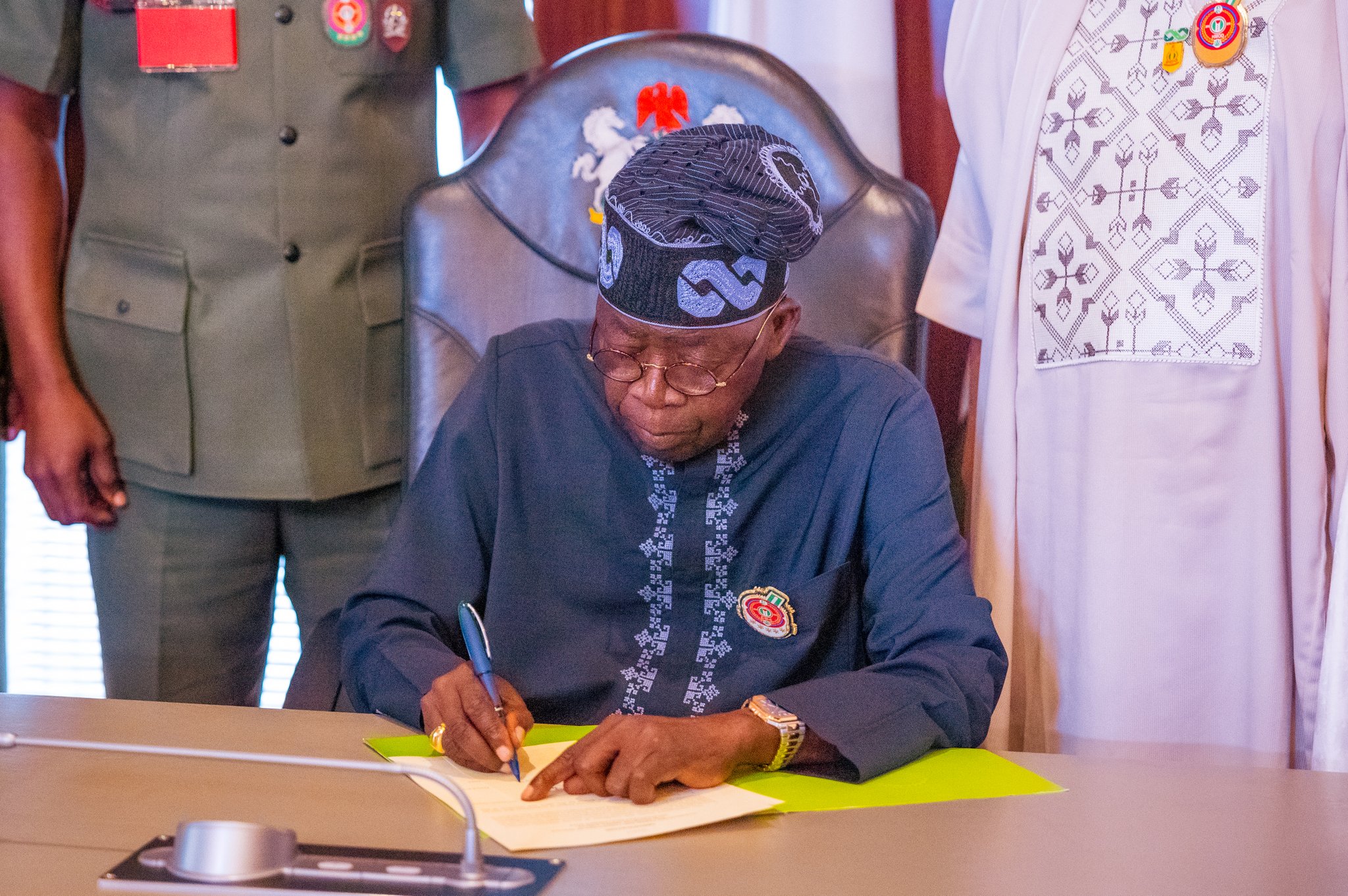
President Tinubu has ordered direct remittance of oil and gas revenues to federation account and cut NNPC deductions.
NewsOnline Nigeria reports that President Bola Tinubu has signed an Executive Order mandating the direct remittance of oil and gas revenues into the Federation Account, in a sweeping reform aimed at boosting transparency, curbing revenue leakages, and strengthening Nigeria’s fiscal position.
The Presidency said the directive seeks to safeguard and enhance oil and gas earnings, eliminate duplicative deductions, and redirect critical resources toward national priorities.
Constitutional Backing for Revenue Reform
The Executive Order, signed pursuant to Section 5 of the Constitution of the Federal Republic of Nigeria (as amended), is anchored on Section 44(3), which vests ownership and control of all minerals, mineral oils, and natural gas in the Government of the Federation.
ALSO: President Tinubu Signs Controversial New Electoral Act 2026 Into Law Amid Protests
The move is also designed to restore constitutional revenue entitlements of the Federal, State, and Local Governments, which the Federal Government argues were weakened by certain provisions of the Petroleum Industry Act.
Review of PIA Deductions
Under the existing PIA framework, NNPC Limited retains:
-
30% of the Federation’s oil revenues as a management fee on Profit Oil and Profit Gas under Production Sharing, Profit Sharing, and Risk Service Contracts;
-
20% of its profits for working capital and future investments;
-
An additional 30% allocation to the Frontier Exploration Fund under Sections 9(4) and (5) of the PIA.
The Presidency described these deductions as excessive and beyond global norms, arguing that they significantly reduce net remittances to the Federation Account.
Under the new order:
-
NNPC Limited will no longer collect or manage the 30% Frontier Exploration Fund.
-
The 30% management fee on profit oil and profit gas will cease.
-
All royalty oil, tax oil, profit oil, profit gas, and other government-entitled interests under production sharing arrangements must be paid directly into the Federation Account.
Gas Flare Penalty Changes
The Executive Order also suspends payments of gas flare penalties into the Midstream and Downstream Gas Infrastructure Fund (MDGIF). Instead, proceeds from gas flaring penalties will now be paid directly into the Federation Account.
The government noted that an Environmental Remediation Fund already exists under the PIA, making certain overlapping allocations redundant.
Structural Reforms and Oversight
The President raised concerns about NNPC Limited’s dual role as a commercial entity and concessionaire under Production Sharing Contracts, stating that the arrangement could create competitive distortions and conflict with its transition to a fully commercial enterprise.
To ensure effective implementation, Tinubu approved:
-
The constitution of a joint project team to execute integrated petroleum operations.
-
The establishment of an implementation committee comprising key officials, including the Minister of Finance, Attorney-General of the Federation, Minister of Budget and National Planning, Minister of State for Petroleum Resources (Oil), Chairman of the Nigeria Revenue Service, and other senior government representatives.
Focus on Fiscal Stability
The Presidency described the reforms as urgent and critical for national budgeting, debt sustainability, economic stability, and improved public welfare.
Tinubu also indicated that his administration will undertake a comprehensive review of the Petroleum Industry Act in consultation with stakeholders to address identified fiscal and structural gaps.
With the Executive Order officially gazetted and effective from February 13, 2026, the Federal Government says the reforms are intended to strengthen public finance management and ensure that oil and gas revenues fully benefit all tiers of government and the Nigerian people.