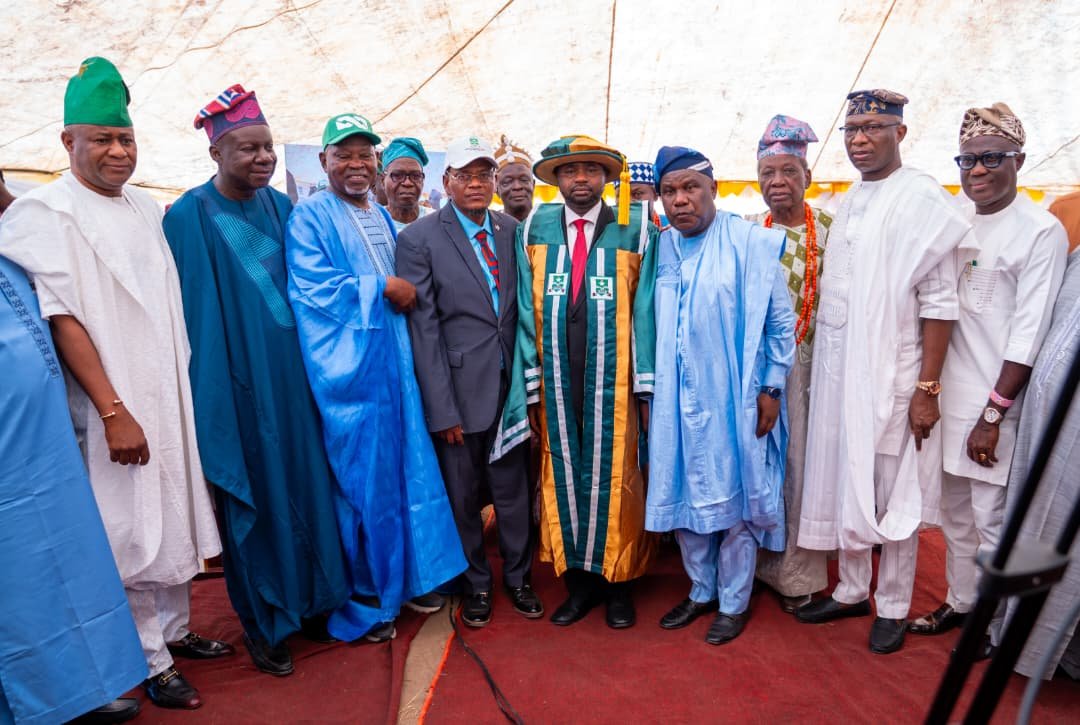
NRS Chairman Adedeji has stated that technology is the key to successful implementation of Nigeria’s new tax laws.
NewsOnline Nigeria reports that the Executive Chairman of the Nigerian Revenue Service (NRS), Zacch Adedeji, has declared that technology will be central to the effective implementation of Nigeria’s newly enacted tax laws.
Adedeji made the assertion on Wednesday while delivering the maiden convocation lecture of the Federal Polytechnic, Ayede, in Ogo-Oluwa Local Government Area of Oyo State.
ALSO: NRS Sets N40.71trn Revenue Target for 2026 After Beating 2025 Goal with N28.3trn
According to a statement issued by his Technical Assistant on Print Media, Sikiru Akinola, the NRS boss identified infrastructure gaps, limited technical skills, trust deficits, and resistance to change as some of the key challenges confronting Nigeria’s tax administration system.
Delivering a lecture titled “The Role of Technology in Implementing Nigeria’s New Tax Laws: Challenges, Prospects, and Implications for National Development,” Adedeji described the new legislation as the most comprehensive overhaul of Nigeria’s fiscal framework in five decades.
He explained that the reforms go beyond adjustments in tax rates and administrative powers, noting that they fundamentally redefine how authority operates within the tax system.
“These laws are not merely changing rates, definitions, or administrative powers. They represent a complete structural overhaul, signaling the end of tax collection as a manual task and the beginning of tax intelligence,” Adedeji stated.
He emphasized that the new tax regime presupposes the existence of reliable taxpayer identification systems, integrated institutional data, traceable transactions, automated processes, and scalable enforcement mechanisms.
“In other words, these laws are built for a digital environment. They cannot function properly in a manual, fragmented, paper-based system. Without technology, the laws remain aspirational. With technology, they become operational,” he said.
Adedeji noted that excessive human discretion in tax administration often breeds inconsistency, mistrust, and non-compliance. He maintained that technology-driven processes would enhance transparency, improve efficiency, and reduce opportunities for manipulation.
He further highlighted that one of the major benefits of a technology-powered tax system is the expansion of the tax base without necessarily increasing tax rates.
“By improving visibility and bringing previously unseen economic activities into the tax net, technology levels the playing field. When compliance broadens, the pressure on existing taxpayers reduces, fairness improves, and legitimacy grows. This is how modern tax systems grow revenue sustainably,” he added.
Also speaking at the event, the Speaker of the House of Representatives, Tajudeen Abbas, urged graduating students to remain committed to lifelong learning and to serve as worthy ambassadors of the institution. He was represented by Senator AbdulFatai Buhari, who commended Adedeji for spearheading reforms in Nigeria’s tax administration.
The Chairman of the institution’s Governing Council, Yakubu Datti, praised the NRS chairman for leading the re-engineering of Nigeria’s tax architecture, while the Rector, Dr. Taofeek Adekunle Abdul-Hameed, encouraged graduates to draw inspiration from Adedeji’s journey, noting that he also began his academic career at a polytechnic.