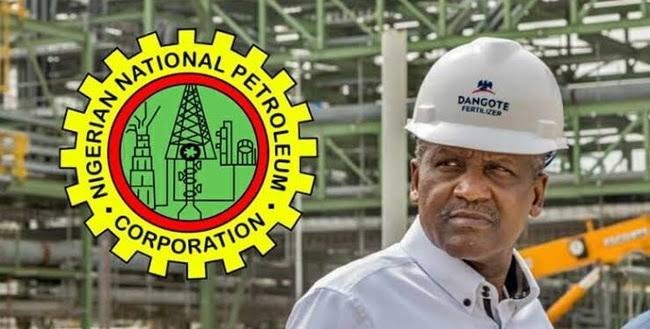
NNPCL has ended its sole purchase agreement with Dangote Refinery.
NewsOnline Nigeria reports that the Nigerian National Petroleum Company Limited (NNPC) has officially ceased its exclusive purchase arrangement with Dangote Refinery, opening the market for other petroleum marketers to buy petrol directly from the refinery.
This significant development, reported by PREMIUM TIMES, shifts the market away from the NNPC’s exclusive purchasing role, providing room for marketers to negotiate prices with Dangote on a “willing buyer, willing seller” basis.
Dangote Refinery, with its 650,000 barrels per day capacity, began producing petrol in September. Initially, Dangote’s Vice President, Devakumar Edwin, noted that the NNPC would be the exclusive buyer.
However, recent statements from the NNPC clarified that the refinery is free to sell to any interested marketer, removing its previous single-offtaker stance.
On 15 September, NNPC began loading petrol from Dangote Refinery, but it initially limited access to major marketers.
Independent marketers, however, were excluded from lifting the product.
Responding to this, Nigeria’s House of Representatives called on the government to instruct both NNPC and Dangote Refinery to allow independent marketers access.
Lawmaker Oboku Oforji expressed concern that excluding independent marketers could foster monopolistic practices, ultimately pushing some marketers to import fuel to stay competitive.
“NNPCL and the major marketers being the exclusive off-takers spells monopoly, which is tantamount to greed. This is the same NNPC Ltd that has failed to manage our crude and refineries for decades,” the lawmaker said at the time.
Further fueling the discussion, sources confirmed to PREMIUM TIMES that NNPC intends to step down as the sole purchaser, enabling direct access to the refinery’s petrol for all marketers.
This change may encourage competitive pricing and help stabilize supply chains. The NNPC spokesperson was unavailable for comment, but an official did confirm the news, stating, “Yes, it is true. We can no longer continue to bear that burden.”
In September, NNPC reportedly purchased petrol from Dangote at ₦898.78 per litre but resold to marketers at ₦765.99 per litre, absorbing a subsidy of nearly ₦133 per litre.
During this period, NNPC lifted approximately 103 million litres of petrol from Dangote Refinery, although only 2,207 of 3,621 scheduled trucks were successfully loaded, accounting for just 26% of the targeted volume.
Market Implications
NNPC’s exit as the exclusive petrol buyer signals a move toward a fully liberalized fuel market in Nigeria, potentially ending petrol subsidies.
With NNPC no longer responsible for the price differential, marketers will now purchase at cost directly from Dangote and set their own prices, which could result in higher fuel prices for consumers.
Additionally, marketers can now source petrol from multiple suppliers, not just Dangote, fostering a more competitive market environment that could contribute to supply stability across Nigeria.
This broader access might also stimulate investment in storage and distribution infrastructure, potentially improving product availability nationwide.